
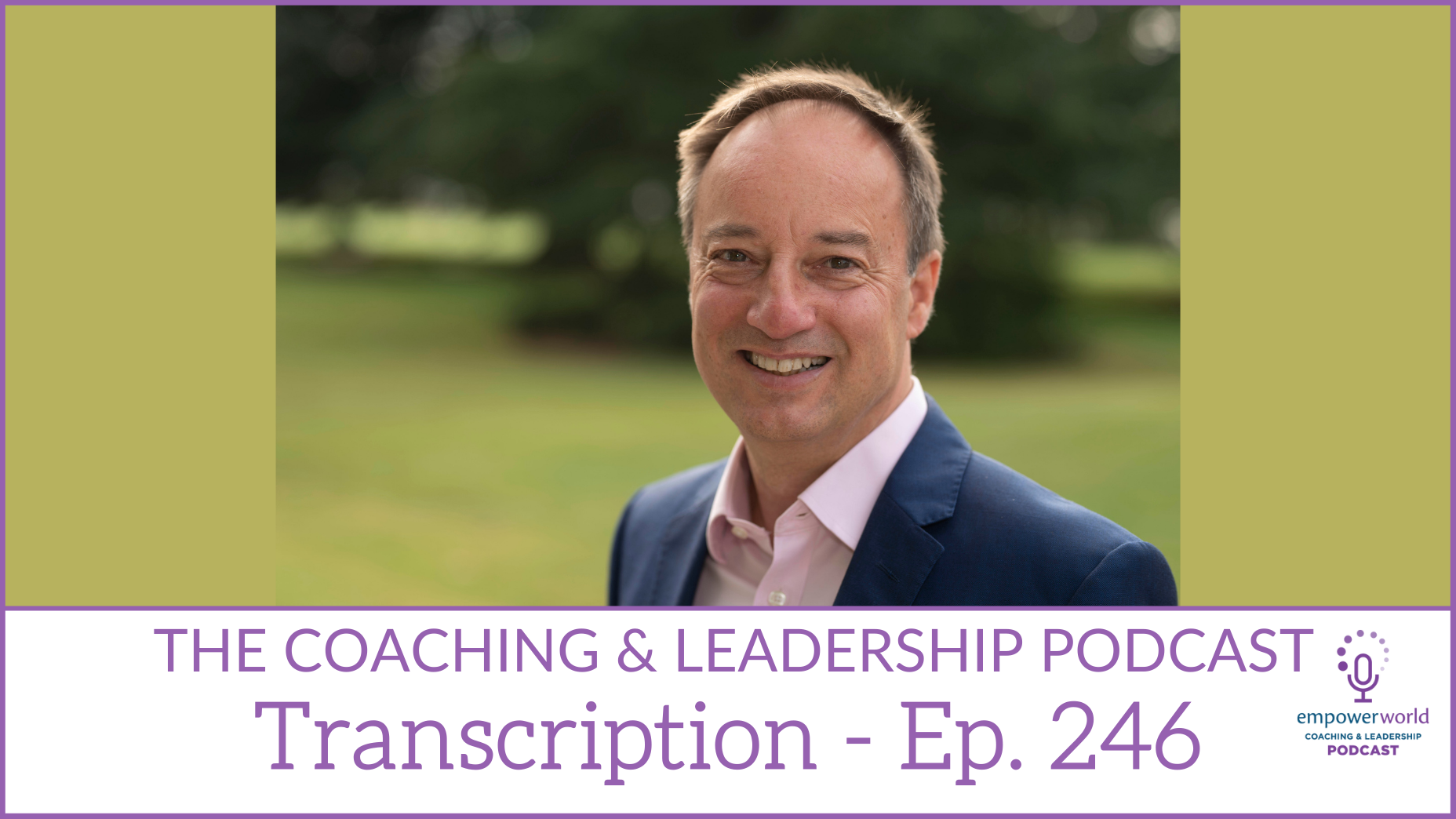
Jonathan Passmore
Professor, Chartered Psychologist, Accredited Coach, and Supervisor.
Jeanine Bailey: Hello, and welcome, listeners, to the next episode of the Empower World Coaching and Leadership podcast. Today I'm with a very special guest, Jonathan Passmore. Jonathan, I'm so pleased that we're able to record this podcast together. I know Marie and I were both keen to meet you, and unfortunately, Marie can't make it today, but I have the pleasure of being here with you. And just very quickly for our audience, Jonathan is one of these incredible coaches who is a prolific researcher, writer, and of course does lots of coaching, executive coaching, leadership work, and so much more, but I'll hand over to Jonathan shortly to share that.
But I just really appreciate Jonathan being in my life. I feel like I know you through all the writings, through all the books—41 books, I believe, to date, and 130 to 140 research pieces. Listeners, there'll be a link that we will share so that you can get some access to some of those wonderful things that Jonathan has contributed to the profession of coaching and leadership.
Thank you, Jonathan. I met you briefly over the recent conference with the AOC, the Coaching in Nature, and that gave me the inspiration to follow up, because I know you've got a book that is coming out, or has come out, Outdoor Coaching: A Practical Guide. It is produced by Ellie Lloyd-Jones, and there's so many more other books that we've been speaking about before we came on, but I'm going to stop talking and hand over to you, Jonathan, to share a little bit about yourself with our audience, who perhaps don't know you yet.
Jonathan Passmore: Well, good morning, nice to connect with you. A little bit about me: I'm a chartered psychologist. I've been involved in coaching for 25 or so years, and over that period of time as a coaching practitioner, as a researcher, as a writer, I've been active in bringing or trying to connect the worlds of evidence-based research with our practice as professional coaches helping leaders and individuals and organizations optimize their performance.
So, the books and the research really, in some respects, just for me, because I'm curious. What does that mean? What does that look like? What would that involve? How could I get better? And research has contributed to my own understanding of the world of coaching. And as I do that, almost like a hobby, I write these up and share those. Over the course of my 25 or more years, I've spent quite a bit of time in organizational work at PricewaterhouseCoopers, IBM, and then more recently at Ezra Coaching. And then between those periods at times in universities, working for East London, and more recently, Henley Business School, where I am Professor of Coaching.
Jeanine Bailey: Fantastic. And again, a huge thank you for your contribution, Jonathan. We know that you are quoted very often in many different circles, and certainly the circles that I move in, so thank you for all that you do.
We have talked about some of the books that have recently been released, and one to come up shortly. They're all things that certainly I'm really curious and passionate about. The Mosaic Leadership book that is to be released in January, which is supporting people to understand the different ways of leading—I think you mentioned around 30 different types, ways of leadership that are introduced in the book. I'm really interested in that, having a business in the Middle East, and certainly strong connections in Australia and New Zealand.
Outdoor Coaching and the practical guide, which, of course, is something that is very dear to me, and something that I think is really important. You also mentioned the Digital and AI Coaches Handbook, which is, I think, on many people's minds: AI.
So, as I reflect those three back to you, Jonathan, what calls you to perhaps be curious about on our call today? Maybe all three, maybe just one, maybe two.
Jonathan Passmore: Well, maybe we'll start with AI and digital. My practice, like probably many of us that go back more than a decade, was face-to-face. So you would invariably catch a bus, or a train, or a tube, and go and meet a client, sit in the lobby, wait for somebody to come and collect you, take you up to the 27th floor, sit in the outer office, wait for your client to be free, go through, have a face-to-face coaching session, and then go away. And in those days of the early 2000s, even in the late 90s, really, all of that work that was going on was face-to-face delivery with senior executives in organizations who wanted to have some space to think, have a sounding board, have somebody to challenge them who was independent outside of the business, didn't have a vested interest.
What we've seen in the world of coaching is, probably during the 2010s, maybe from 2012, 13 onwards, a few of us started to dabble with Skype and occasionally meet clients. And that gradually was increasing, but what we saw in 2020, during lockdown, is that all of us shifted online. And that process of moving online has then triggered and seen the growth of digital coaching companies like Ezra. So, for us at Ezra, we are doing hundreds of thousands of coaching sessions a year through 2,000 plus coaches, because we're able to then scale coaching. We're able to offer organizations the data from all of this, and the convenience, which means that as prices have fallen in the coaching industry, organizations have seen the power and have the purchasing power to then cascade coaching down from the 27th floor down, down, down the business, enabling more people to leverage coaching. But as we've done that, it's gone online.
And that online process: there are similarities. Clearly we're still listening, we're still asking powerful questions to encourage people to reflect. We're still helping people to navigate through difficult choices, dilemmas, decisions, and enabling them to identify what the right options are as an insight or an action to take away, and holding them to account. So all of that remains the same, but there are subtle differences in working online.
And then more recently, of course, we've seen the emergence of generative AI, and many companies starting to introduce generative AI coaching tools—tools that help leaders and managers and contributors to reflect on what they're doing to improve. So, the book really emerged from that transition from the professional coaching that emerged in the 1990s to where we are now in the 2020s, where there is still face-to-face, but increasingly, maybe dominantly, digital coaching, human-to-human coaching, is probably the most common medium for delivery. And alongside of that, many organizations are curious about AI and how they start to use this while optimizing digital coaching. So the purpose of that book was to try and bring together a range of experts in different areas to help people think through those dilemmas, not only as coaches, but also as buyers of coaching. What are some of the things that we need to do when we think about cybersecurity? What are some of the things that we need to be doing as we manage a large portfolio of coaches, maybe through a coaching provider such as Ezra. So that book, published in the last year with Routledge, has been popular and has certainly engaged lots of people in thinking about their coaching practice, and how should they improve it.
And there's also, with AI's increasing popularity, got many of us thinking about what is the place for AI in coaching? And that, for me, has then triggered a whole range of research projects that we could or could not talk about today, trying to tease out where does AI add the most value, and where are humans special, different, and how, particularly, do we as human coaches differentiate ourselves from the emergence of these AI tools? So it explores many of those themes. But of course, it's also a field where it's continuing to change, develop, and grow, because technology changes and develops and grows so quickly at the moment.
Jeanine Bailey: Mmm, absolutely. And so that's the question that's coming up for me. When you share, Jonathan, what are the implications of AI in coaching? And what differentiates that between AI and the human side of coaching? I have my own thoughts and ideas, but I'm curious to hear yours.
Jonathan Passmore: Well, we identified a number of themes that we think are factors where humans, if we as human coaches dial these up, they are differentiators to the potential that AI has and will have over the coming decade. So AI, interestingly, is fantastic at listening—if you can call a computer, it listens. Gathering information from what's said, and then turning that back into a summary and an open question. So it's really good at doing that. It's better than most novice coaches, it's as good as most professional coaches. But what it's less good at doing is the things that are distinctively human. One of those is humor.
Humor is something unusual for us as a species, and it's not, when we're using the word humor, the joke. A joke is a performance; it's a script that we have previously rehearsed and we tell. And humor is something that is a connection between two people. It is often relational, so it's something that you and I share that maybe, based on our conversation chatting just before we got started, I might say something that connects to that conversation, and you might laugh because it's picked up, it's an echo of something we were talking about, a story that we have shared. But for other people who weren't part of that conversation, listeners who are tuning into the podcast go, what's that about? I just don't get it. So it's often relational, and it's also situational. What might be funny in this call, because I've echoed something that we were only talking about 10 minutes ago, may not be funny in 3 months or 6 months' time, when we talk again.
The skill of a human in their interactions with others is choosing something that is an echo of something between you and me that we share, and choosing the right moment to bring this in. AI's not very good at doing that. It can tell a joke, not usually a very good joke. My children would say it's a dad joke that AI might tell. I think they're funny, but it's still a joke, not humor. So there's something special about that.
Other things that we are exploring at the moment in our research projects are work experience. I can scrape the internet for stories that other people have shared, but it isn't something that AI has personal, lived experience of. And I think there is something different when we connect with a human coach who has been, let's say, an accountant or a senior leader, and has lived through the last 3, 5, 25 years in the world of work, and they bring that into the way they understand and make sense of the experience I, as a client, am having. It informs the way they frame the questions, and it also allows me to say, I want this type of coach rather than that. So I think humans often place credibility on people's previous experience. AI has no credibility, even though it might know everything, it might have gathered together all human knowledge by scraping the internet, it's still not an authentic, lived experience.
So, career experience, and the second side of that coin, is the identity experience that many coaches bring, and that informs the way that they have experienced life, and how they then engage with their clients. And I think this is particularly resonant. It's not unique or only restricted to these groups, but it's particularly resonant with women. So we see many female coaches promoting themselves as a women's coach, a female coach, helping women leaders. It's particularly resonant for people of color. It can be resonant for faith and neurodiversity, which are other features, other identities that people wear.
Now, I'm not saying that there aren't other groups, but we can see that coming through in the way that people then say, I want a woman as my coach, because the issues that I'm working with are about working in a male-dominated environment, and how I, as a woman, break through or impact in this environment. Rightly or wrongly, some women want to make that choice, and they want to choose a woman coach, and women coaches are then promoting themselves to then attract that type of client, because they're able to draw on their own experience of encountering those challenges. They're able to empathize and frame questions in a different way than maybe I, as a male coach, would be framing those questions. And even if there is no difference, the difference is perceived by the client, so they're choosing someone for their identity, and they feel, in the coaching sessions, there is a difference. So there's this third thing.
Other themes that we're looking at is the difference between cognitive and affective empathy. I might be able to think about how you feel, but when I feel how you feel, that is experienced by you in a different way. So I can see, because you're really nicely lit today, I can see how dilated your pupil is, and that gives me some information about your emotional state. I can see how much moisture is in your eye. And if we were to move on to a sensitive topic, then, maybe, for you, that would trigger a different emotional reaction than the emotion you're experiencing at the moment. And so that might lead to dilation of your pupil, it might lead to an increasing amount of moisture in your eye. It might mean that you cry. My response to that as a fellow human being is probably to affect my emotional systems as well. You will see that in changes maybe in the amount of moisture in my eye, and changes in my skin coloration and my facial expressions. All of that is that affective emotion that, at the moment, a computer's not able to replicate. And if we do have the technology to do some of those things, which we're progressing towards, that technology's expensive and isn't available in the same way that a laptop is available for pretty much every employee who works in an office-based environment.
So we're exploring those themes, and there are about half a dozen that we're having a look at, that I think if we as human coaches dial these aspects up—focus more on identity, share more of our work experience, bring in more humor, focus more on the emotional aspects of our work, and the values—then I think that we can create a different type of conversation than AI is able to have. Not that AI has no value; AI might be sitting alongside the human coach. And human coaching focuses on these aspects, and AI coaching is great at 2 o'clock in the morning. I can't get my coach at 2 o'clock in the morning. I'm worrying about a problem that I've got tomorrow, a presentation, whatever it may be, I can't get hold of my human coach, but I can have a 5-minute conversation to think through this problem at 2am, switch off my phone, and go to sleep, because I've been able to think it through, and I've got a plan. So they have different roles, and if we're able to bring these into the ecosystem of coaching that allow clients to make the right choice for the right problem at the right time, then I think coaching is enhanced by the offering of greater flexibility, greater variety in the coaching offer.
Jeanine Bailey: Yes, fantastic, Jonathan. Thank you for responding to that question so articulately, and with lots of information that's really helpful. I totally resonate with what you are sharing. I think AI does have a place. I personally haven't used AI for myself. I think I need to try it out. I'm still down the old-fashioned route of meeting certainly somebody one-to-one over digital.
Jonathan Passmore: Well, as a coach, let me recommend Wunder. So this is a platform that would help you to reflect on your coaching practice, and if you're a professional coach, it can give you feedback, a little bit like a mentor or a supervisor, to help you to improve in a coaching-based style. So, that may be a platform to check out, and I'll share with you the link, and people can go and have a look at that, if that's interesting. Clearly, I work for Ezra, and we have Kai, which is a great coaching platform, and we've got tens of thousands of people this year who have been using Kai. And we have tended to use it as a complement to human coaching, so it acts almost as the intersessional activity between the human coaching sessions. Kai comes in to encourage people to reflect on maybe the activities that they've engaged with, maybe the plan that they've developed, and just in a short 3 or 4 question, 2, 3, 4, 5 minute interaction helps people to continue to drive forward towards their goals, and then you come back in with a human coaching conversation. So, people might want to check out those two.
Jeanine Bailey: Yeah, thank you for sharing that, and I will definitely have a look at that. We at Empower World, you know, we're exploring how we can bring in AI in a way that resonates with us and what we do. We certainly, like I can hear you, Jonathan, we… when we support our reflective partners, our thinking partners, you know, we're keeping our whole self open to the emotions that come through, the physiology that changes, those things like moisture, as you say, in someone's eyes, or… we're really paying attention to our intuition, what's happening in the system that potentially we are experiencing from our partner. And we're also really curious about what's coming up for the partner in terms of their intuition.
So, I really appreciated what you were sharing earlier about the identity piece as well, because even though we know as coaches, we aim as much as possible to be neutral, I think bringing in somebody that you have resonance with, that you identify with, that there'll be trust there, there'll potentially be that trust to be able to for the thinking partner to be able to be their authentic self, and bring out what's truly important. And what I'm also hearing is there is this wonderful opportunity for us as coaches to develop our mastery, to develop our ability to pick up on all those potential invisible clues that AI, at the moment, does not pick up. So I hear there's this wonderful opportunity. And of course, there are people who just want to relate to a human being, and of course, there are others that just want to relate to something anonymous, so I hear there's opportunities for everybody here.
Jonathan Passmore: I think that that's right. And certainly what we found in a paper that copies on our website, jonathanpassmore.com, when we ask people about their preferences—so we had a series of criteria comparing human and AI—there were a proportion, a small proportion, about 10%, not statistically significant because the sample was very small, but a small proportion of people who were saying, actually, we rate the AI coach in a similar way to people who were rating the human coach. They were different, so different participants in each group, so we let people choose whether they wanted a human coach or an AI. And in this situation, it might be that some people, some personality types, are particularly drawn towards an AI coach, or it could be, depending on the topic, that people are drawn towards… well, this is something that I maybe I have a higher level of embarrassment or shame about, and if I know that I'm just talking to a machine, I don't need to be embarrassed by this machine, in the same way that if I don't get my Hoover out to Hoover in the hallway, I'm not embarrassed, because I didn't get it out yesterday, and the hall was a little bit messy, and I get it out today, and the Hoover goes, oh, a bit messy today, should have Hoovered yesterday, shouldn't you? It doesn't do that, and more to the point, I don't mind if it did, because you're a machine! I'm not embarrassed by it. Whereas, maybe if friends came round, and they came into my hallway, said, gosh, you're letting the place go, I might feel embarrassed by that. So, judgment by humans is different than judgment by a machine. And that might be a factor that might mean that we might be more inclined to choose embarrassing or potentially shameful topics to talk about with a machine, and maybe more emotional topics to talk about with a human. And then, a variety of choices: at 2AM in the morning, I'm going to choose the machine. I can book in advance for a session on Thursday, and I want to go in-depth and talk about identity and values, then I'm going to choose a human. So, each might have its place.
Jeanine Bailey: Yeah, absolutely. I hear it, and especially in these days and times, everybody, and I'm sure you have too, believes that everybody needs a coach, or could do with a coach. And now what I'm hearing is the opportunity for everybody to actually have a coach, whether it be person-to-person, or through AI. It's making it so much more available.
Jonathan Passmore: I… Coaching, I think, during the 2000s, saw itself as being something special. And here we are as coaches, we've assumed an identity for this role. But I don't think coaching is special. I think, as humans, we have been coaching each other for tens and hundreds of thousands of years. If we look at Indigenous peoples, we look at hunter-gatherers, probably as they were moving from valley to valley, and location to location, they were probably using coaching. We, as coaches, know coaching's fabulous for learning and development, and it's particularly great for learning and development in dynamic environments. And there's no more dynamic environment than when you're having to physically move home from one valley to another, you're carrying your teepee or your hut with you, and you're going out into a different landscape. What you want to find in that landscape is to teach the next generation, given that you have probably only got a life expectancy of 30 years. How do you pass on knowledge really quickly that is criteria-based?
In a stable environment where the apple tree is outside of your front door, you might say to your child or the younger member of your tribe, go out, go and pick some apples. Go to the hen house, collect 6 eggs. There we go, you've collected. Whereas if you're in a different location, you've got to think about, where's the light shining at this time of year? Where are some of the tracks? What are some of the species, animals or fruiting species that we might start to look for, where are they most likely to be growing? So, it's a different environment, it's a dynamic environment that's changing, and so probably our ancient ancestors were using coaching as a conversational-based approach to encourage younger generations to identify the criteria, learn, and get better at hunter-gathering.
And, in a way, we've reinvented that. We've discovered it anew in the 2000s, and so we're saying, now there's something special. Great coaches were probably our grannies, and certainly our great-great-great-great-great-great-grandfathers and mothers, who were doing that and have probably been doing it. What's a pity is that they didn't do cave paintings of the GROW model. But, you know, only bison and other animals.
Jeanine Bailey: In their own unique language, potentially, it was there.
Jonathan Passmore: Absolutely, absolutely.
Jeanine Bailey: Yes, I agree, and yes, as you say, in the 2000s, we've made it more special, but actually, we really want everybody to have that ability to have that option to be coached when they're ready, when they're ready for change, and… they're ready to hear feedback, or whatever it may be, to be able to create what they desire.
Jonathan Passmore: And you make the right point that all of us can benefit. If we have a growth mindset, if we have a mindset where we want to get better, coaching is a fabulous tool for that. So we should all have a coach, arguably, all of the time. That coach should be helping us to reflect, helping us to be challenged, to grow, to hold us to account. And if you're an Olympic athlete or an elite sports person, you certainly have a psychologist, a coach who's helping you to reflect on what you're doing well, what you're doing less well, and what your journey, what your plan might be to get better. And if you're somebody in the workplace who wants to improve what they're doing, a coach is the obvious answer. We should all have a coach.
Jeanine Bailey: Yes, yes, I totally agree. I so wish—I'm putting in inverted commas—I had discovered coaching in my very early days. However, it came when it came, which was a few decades later, and it's been an incredible journey. And I feel that these skills that we have learned and developed and passed on are much needed in these days of much stress. I often say to my team, if I hadn't have learned these skills, I'm not quite sure how I would get through day-to-day, but the skills that I have learned and the experiences I've had enables me to navigate what seems to be very challenging times.
Yeah. My hope is, again, that many more people realize and recognize that coaching is available to them through, as you say, through AI, and also with face-to-face or digital coaching.
So, Jonathan, potentially now is probably a good time to wrap up. I know that there were other topics that we touched on that were incredibly inspiring, so I hope that we can continue the conversation soon. I'm particularly interested in your upcoming book, The Mosaic Leadership Book, so we'd love to meet you again and hear your insights based on that particular book. So, as we do wrap up, Jonathan, what might be your imparting wise words for our listeners that you'd like to share?
Jonathan Passmore: So I would encourage people to not stop growing, to continue to have an open mindset. And one of the things that I notice about, I guess, the coaching industry is a gradual shift that is happening towards more evidence, to pay more attention to research, and to think as you read many of the articles—and there are hundreds of articles for free available on my website, and I think you're going to share that as part of the notes—ask a question: What does this tell me about my coaching practice? What one thing could I take away to enhance the work that I do in service of my clients?
Jeanine Bailey: Beautiful. Thank you, Jonathan. Again, really appreciate your time. Thank you for all that you do in the profession of coaching and beyond, leadership and beyond. So, I look forward to… Marie and I both look forward to meeting you again and having another powerful, empowering conversation. Thank you.
Jonathan Passmore: Thank you.


