
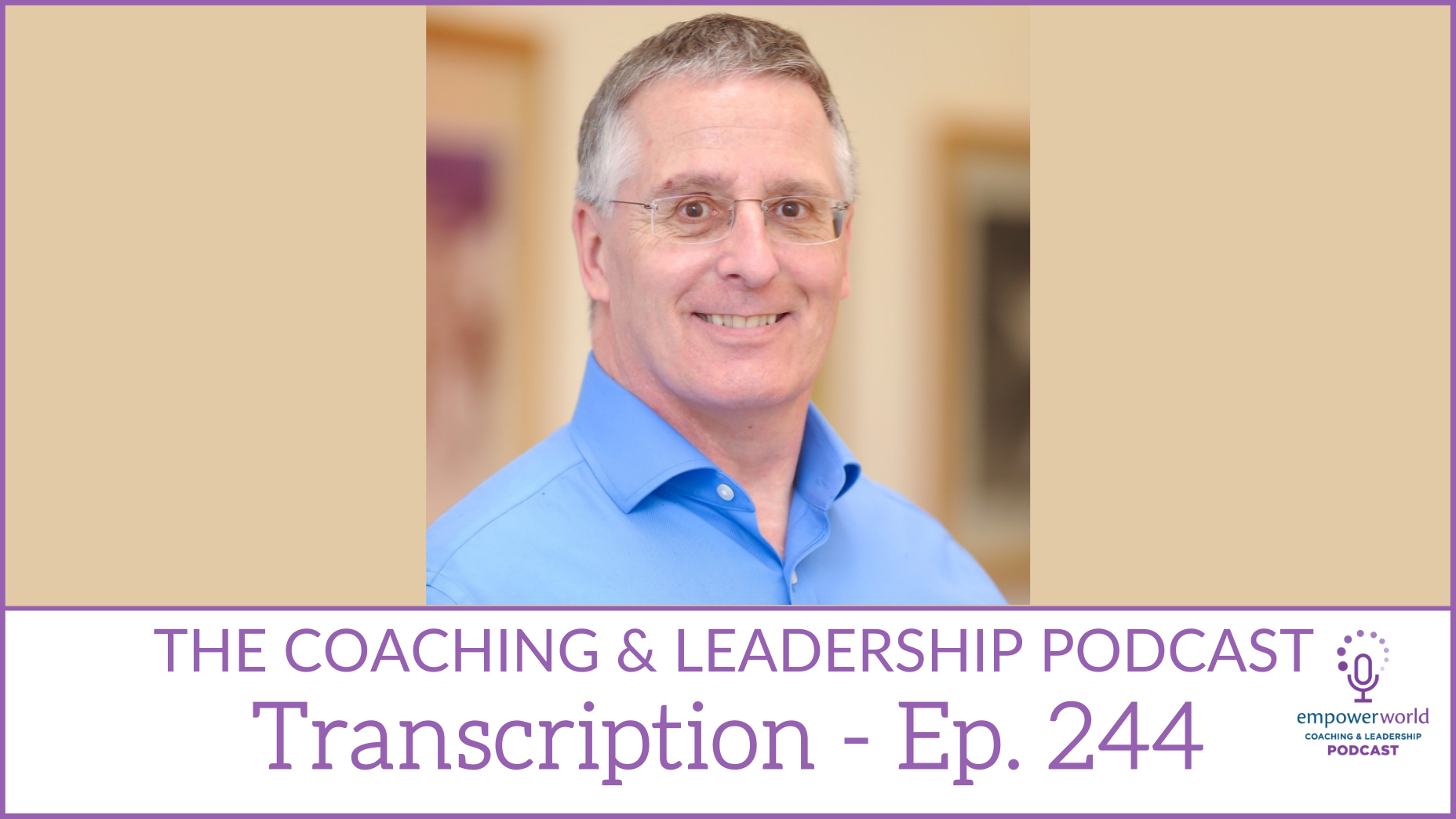
Ian Day
Leadership Coach & Course Director, Warwick University.
Marie Quigley: Hello and welcome to this episode of the Empower World Coaching and Leadership Podcast. As you know, my name's Marie Quigley, and today I'm speaking with the very inspiring Ian Day, who is a highly skilled leadership coach. He's a speaker and author with over 20 years' experience working with C-suite leaders. And senior teams in complex, high-pressure environment. Ian is a chartered coaching psychologist, get my teeth back in, and a fellow of the CIPD. Ian brings both psychological insight and practical business acumen to his work. Ian, welcome to the podcast.
Ian Day: Thank you very much, Marie, great to be here.
Marie Quigley: It's really kind of you to say yes. I know you're a busy man, so finding time, is very generous of you.
Ian Day: Well, I love coaching, so I'm always very happy to spend time talking about coaching and sharing knowledge, because that's what people did with me, and have always done. So, I think it's important to share, and it's just a wonderful community to share and discuss with, so thank you for the invitation.
Marie Quigley: Yeah, we believe the same, Ian. That's why we set up the podcast, actually, probably about 14 years ago now, because we wanted coaches to be able to hear from other experts in the field the different philosophies, the different ways of coaching. As we know, there is no one way, but there's lots of good ways that experienced coaches can come and share their knowledge and experience with those who coming behind us. So, I gave you a little bit of an introduction, Ian. What did I miss out in who you are? Who is Ian Day that might be even more exciting than I introduced?
Ian Day: Well, yeah, sometimes when people introduce me, because I've been lucky enough to present at a number of conferences, and it sounds a little bit detached from reality, because I'm just an ordinary bloke from Birmingham in England, and I started off my career in human resources, and I didn't expect to be interviewed on podcasts and things like that, or write books or publish books. In fact, it was… it was never on my radar, so when you introduced me, now I'm sort of… 20, 25 years down the road of coaching. It sounds, oh, that sounds… that's quite impressive. But it's almost remembering that we all start in the same place. And, Yeah, I remember… I remember… I was… I was in a corporate HR role, and I was… I was promoted, and, my boss said, I've… I think you'd benefit from coaching. I've got you this coach. And it… this guy came up from London to Birmingham. and coached me every month for 12 months, and that was… that was mind-boggling. It was the best thing that had ever happened to me. Absolutely, absolutely wonderful. Never experienced anything like it. And that started me off on my journey, and I became a qualified coach. And so, I started where we've all started, as a novice coaching, not knowing what to do, not knowing how to ask a question, not knowing how to listen. And… all these years later, here I am. So it's almost like, well, anybody could be doing what I'm doing.
Marie Quigley: Cool.
Ian Day: Yeah. to you.
Marie Quigley: Yeah, I love what you say. So, you came into coaching because you had a coaching experience that really… kind of offered you something, perhaps, that you hadn't experienced before, and you thought, gosh, that has some impact, I might like to do that. And I also appreciate the fact that it wasn't a one-off coaching session, but it was a Program… a program over a year period for you to look at yourself on a monthly basis, to do some thinking around yourself. That… because often people will say, oh, you know, short coaching's a short-term… short-term thing. And it can go on a lot longer than we think. You know, I've got clients who are still with me, not on a regular basis, not on a monthly basis, but who have stayed with me for 5, 6 years, because the check-in of having a coach to support them on this leadership journey is so essential.
Ian Day: Yeah, I think that's the… almost like the luxury of coaching, that you've got that depth, and you've got that trust. So, the guy that coached me, he's still a friend and a mentor after all these years, but that depth of relationship. it does… it does develop over time, and it's… it's… it's really, really significant, and really precious, because I think that was the only time that I talked about myself, I mean…
Marie Quigley: I'd… I was in a head of talent role, and I'd… I'd commissioned.
Ian Day: leadership development programs. I'd done that for a while, but I'd never commissioned a coaching program. I was relatively new to coaching. We were talking 25 years ago, so, you know, it was established and relatively new. And… and so it… although I'd commissioned and I'd experienced a lot of leadership development programs. There was nothing as powerful as this one-to-one coaching, just having somebody listen to you, and it's just… it's just so precious, the space and time. to understand your own thinking, and what's the significance of that, what does it mean? It helped me understand who I was, who I am as a person, and my values. And it was just… it was life-changing, because that set me off on this journey that I've continued on for all these years.
Marie Quigley: Yeah, that's beautiful. And, of course, I first came across your work from your book, Challenging Coaching, which really gave us all a kick up the boot, you know, the loving boot, to get us thinking about this thing that often is thought of as Maybe soft and gentle, and supportive, and you brought in this concept of the loving boot, and so much more than that in your challenging coaching. that… enabled, I think, coaches to look at both sides of The coin, and all around the coin, the circumference of the coin, to support people to think about how can I support, yet challenge leaders in a way, perhaps, that they aren't? I know I work with a lot of CEOs, and they don't get the challenge that they want because of their level.
Ian Day: Yeah, and that's so, so important. But it's, it's, when I wrote the… co-wrote it with, John Blakey, when we wrote the book, it was almost like there was a dissatisfaction with coaching, because there was the sort of the notion of the person-centered coaching approach, and you'd follow the agenda of the coachee, the client, And it was almost like you as a coach were not present in the room. You try and keep yourself detached in a way. And it never felt… I never felt particularly comfortable. And when I… when I would talk to my senior clients, and they said, well, what did you value? What was your feedback about that coaching session? They said, when you challenged me.
Marie Quigley: When you encouraged me to question myself and my decisions. And so there was this, almost like this absence.
Ian Day: of what the professional bodies were suggesting in terms of coaching competencies, and what my clients were suggesting they valued. And, yeah, it didn't… it didn't seem… it didn't seem quite right. And I… I… I remember the… Going back to when I was coached, there was a particularly challenging coaching session where I was in tears at the end of it. In a very positive way, not in an aggressive way, but the realization that I had during… I was… I was in tears, and it was incredibly powerful and needed. So… But the word challenge… It can, it can… it can be quite confrontational. So, challenging coaching, it didn't get an easy start in life. It was… it was not really accepted to start off with, because it was… it was… it was very different to the normal approach to coaching. But over time, it's… it's received a lot of interest, and almost become accepted. So, luckily, I've been able to travel and present and talk about that, and it's been great. But to start off with, it was… it was almost like, Challenge was something that coaches don't do. And I admit, when I went into coaching to start off with, I hoped… I hoped I was a nice person that was going to help my clients. so challenge was not something that I wanted to do, because it was almost like challenge as a word, it's association with Confrontation, and aggression, and… But it's… it's not that. It's about… it's about accepting the person who they are, and just trying to encourage them to look at the world in a different way. So, whatever assumptions what they have, assumptions, limiting beliefs, whatever they might be, let's just… highlight that that could be an assumption, it could be a limiting belief, there could be a different perspective, and encouraging people to think. differently, and it is just challenging assumptions. I think that's a way of putting it. Rather, it's not about challenging the individual, it's challenging assumptions and beliefs and suggesting alternative perspectives.
Marie Quigley: Yeah, totally agree. And to do that, we need to contract… contract well around that.
Ian Day: You know, I think about also provocation in the language of coaching. How useful a provocative reflection or a provocative question can be.
Marie Quigley: And yet, we do need to have safety and security to be able to challenge in that way. So I think when I'm supervising coaches, I notice that they can't do that because the contracting hasn't been strong enough around building up the Connection, to be able… the permission as well, to be able to do that kind of work.
Ian Day: Yeah, absolutely. So that's… that's so, so important. It can be neglected, the sort of the… I know people talk about the psychological safety, but it's so important to have an explicit understanding of what that psychological safety really, really means. And I… one of the things that, is missing from challenging coaching is almost like the underlying beliefs, underlying philosophy. that I bring when… when coaching. So it's… it's based on, sort of, the humanistic approach that people are whole, resourceful, they can find their own Solutions and way forward. And so, some of the people that influence me have been people like Carl Rogers, who's one of the founders of some of the coaching counselling approaches, and he's got some core conditions, and there's… three of those particularly are empathy, unconditional positive regard. and congruence. And if I have unconditional positive regard to my… towards my clients, that I believe they are great, resourceful, whole, capable of… of marvelous things, and if I… if I have that belief. then I can challenge them. So, I don't believe they're broken, I don't believe they need to be fixed, I believe they're whole and resourceful, and so… I can challenge them from an unconditional positive place, that it's my role to help them achieve whatever they state they want to achieve. They want to achieve an objective, or a way of being, whatever it might be, it's for me to help them achieve that. And so that unconditional positive grat enables me to challenge, and that might be missing… well, it is missing from the book Challenge and Coaching, but it's definitely an underlying principle that I have.
Marie Quigley: Yeah, me too. Absolutely, me too. And so… you've written your book, you're doing all your amazing work, and then you decide to write another book. And I'm in the process of writing my own book.
Ian Day: Fantastic.
Marie Quigley: And it's one of the most challenging things I've done, because what I thought I was going to write about has evolved into something completely new and organic. So, what inspired you to write your next book? the coaching leader, Coaching Skills for Leading Through Complexity. I'd love to explore that, because that's very new on the shelves.
Ian Day: It is, it's…
Marie Quigley: Nikko.
Ian Day: It's hot off the presses. It was published in October, so it's hot off the presses. But, yeah, and it's been a while, so Challenging Coaching was published in 2012. And this one is… was out a couple of months ago, in 2025. So, it's… it's been a while. It's… it's… it's been a while. So I've… I've contributed, chapters… to other books that, you know, textbooks, handbooks on coaching. I've contributed chapters to those, but I suppose I haven't written anything myself for a while, and it was… it was an itch that needed to be scratched for a number of… for a number of reasons. I suppose challenging coaching was a wonderful thing. But I co-wrote it, so it's almost like, well, I want you to prove that I can write a book by myself. But also, I had, I had a bit of an illness, and so I had a cardiac arrest, and my heart stopped, and I had hypoxic brain damage, which I'm still… living with. So it's almost like I wanted to prove, as part of my recovery journey, which I'm still on, that I can writes and produce something. So it's almost like… It's almost like a symbolic recognition that I'm… almost… as I was… Before my cardiac arrest. So it was… it was because of that, I stubbornly wanted to write a book by myself to prove that I could do it. It was a demonstration of my recovery. And also, I was dissatisfied with what I saw in leadership, and I thought, there's a new way of doing things. So all of these things sort of came together, and it was a niche that I had to scratch, and I sort of been developing it, and thinking about it, and… drafting and creating the skeleton of what the book would look like. I'd been doing that for a number of years. And I'm now in this wonderful world where I'm an academic, so I run the postgraduate coaching courses at the University of Warwick. And I was able to take a sabbatical. So, they granted me a sabbatical to, complete the book, which was absolutely wonderful. So, that was part of 2025, where I took this sabbatical to write the book, and Yeah, it was completed and published, so the itch was well and truly scratched.
Marie Quigley: Well, thank you for sharing about what happened and… and the consequence of what happened as a result of your health. I have to say, when you shared that, I got kind of a weight on my chest and felt deep compassion for you, recognizing how… You are also… when we… when that hap… something like that happens, you are also leading yourself through the complexity of having to come back to the world in whatever capacity You can. Is it okay if you share what lessons you learned through that, Ian? Because it's just profound, I think, to have these moments in our life that.
Ian Day: Hmm.
Marie Quigley: And teach us so much.
Ian Day: Well, yeah, absolutely, I'm very open about it, and I've written about it, and I talk about it, and I post on LinkedIn about it, because I think it's important. For people to know, because, when you see somebody, particularly There's no… there's no visual sign of an illness, or a difficulty, or whatever, so there's the… with a lot of people, there's these hidden disabilities, and we don't… we don't… we just don't know, but there can be… disabilities that… we're not aware of. And it's important to… for me to speak and share, and there's been people that I've met over the years who've had brain injuries, and, we've, we've had wonderful conversations, and it's almost like playing Snap. Oh, I got that, I've got that, I've got… but it's a real… you know, it's a bit of gallows humor, but it's a bit silly, but, it can be very supportive, but we've got to talk, and particularly with men.
Marie Quigley: Yeah.
Ian Day: we've got to have ability to… to want to talk. So I put myself out there as saying that I had this, I had a cardiac arrest, I, I had hypoxic brain damage because my brain was starved of oxygen, and I had a lengthy… lengthy recovery, and I'm… I'm still… have issues relating to that, and I'm very happy to talk and help, and Just share with… with others that might be on that, beyond that journey, because it's, it's amazing, the things I've learned through that is… it's not… it's not just personal things, it's… it's… yeah, I can be resilient, I can be, determined, but all of that is less important, but it's the people around you that are most important. My wife and my daughter were wonderful. Through my recovery, and still are incredibly supportive in terms of helping with my physical therapy and helping with all of the things That I… that I went through. So it's… I think in almost like anything we do, it's who have you got around you? And I think… I think about… in… in… with the… with the new book, I… I acknowledge, various people, including my wife and daughter in particular, but in terms of the coaching supervision group I'm part of, I acknowledge the people that have helped me in that process. I'm a, as you mentioned, I'm a chartered coaching psychologist, and I'm… part of a peer group, Division of Coaching Psychology peer group. And the people that I meet with on a six-weekly basis, I've also acknowledged, because they've been incredibly significant in helping me develop the book, but also in my recovery, they might not realize. But they have. So it's almost like… In anything we do, who can you surround yourself with? That can help you. Help you be the person that you really want to be. And I think that's the wonderful thing. And again. Going back all those years ago. when I was being coached for the very first time, I was, In terms of Myers-Briggs type indicator, the personality profile. There's introversion and extroversion, and I'm very much an introvert. So that's sort of internal processing, internal thinking. And my coach said… we were talking about a particular issue, a particular problem, all these… all those years ago. My coach said, who have you spoken to about this? I was completely dumbfounded. That was just such an obvious question, but being an introvert, the only person I'd spoken to was myself. So I had this issue, I hadn't been able to solve it, and he said, well, who have you spoken to? And I… Oh, no one. Why would you ask that question? But… it's quite clear. speak to others. And again, that is a lesson that has lasted For 25 years, that speak to people, talk to people, surround yourself And, so… That's almost like a lesson that's helped me with my career in coaching, but has particularly helped me with my recovery. Surround myself with people that can help. And support in, in, in, in anything.
Marie Quigley: Which is wonderful. Yeah, thank you for sharing that, Ian. I think there's so many lessons in that. And so, you know, that relates to leadership… to leadership in so many ways, because When people get to the top of the ladder, they often have no one to talk to, or the people that they talk to only share what they want them to hear, so are not challenging, or not provocative, or not able to support people to think in the lovely way that your coach did. asking powerful questions to support their thinking. So if we… if we come to your new book, which is about the leadership landscape in the complexity that we're living in, that we're living in a very different world than we began coaching in, right? So there's so many more systems that are impacting leadership, and how we… turn up and lead in our life as well as our work. So, take us through some of the concepts in the book. And… Why should a coaching approach be considered when thinking about leadership?
Ian Day: Yeah, thank you. Again, it was this dissatisfaction. I suppose when I wrote Challenging Coaching, it was a dissatisfaction with coaching, the profession, and what it was… it seemed to be limited. And then… then with the… the coaching leader, it seemed to be a dissatisfaction with leadership, because we just seemed to be facing the same problems, and… I don't know about you, but I love leadership books, I love coaching books, and these cupboards are full of Coaching books and leadership books. But it seems to be that we're… we still haven't… we still haven't moved on. We still seem to be facing the same problems, and I… there were… there were news articles that I was reading. And it was about toxic cultures in organizations, and the amount of stress, and bullying, and the amount of stress leaders were under. And it seemed to be that, well, actually, things seemed to be getting worse. And… I was thinking, well. we've… we've got all these wonderful books, I've got all these wonderful books in my cupboards about leadership, but… are they just sitting in cupboards and not… doing anything. So, there's lots of wonderful theories, and many theories that have Been around for a long time, but… It was almost like we seemed to be… stuck. Or almost, it's almost gone round in circles, I don't know, because there seemed to be an increasing amount of pressure, and maybe that was because of… the challenges of COVID, and lockdown, and cost of living crisis, and organization struggling in that environment. But almost like things were… things were really difficult, and organizations were getting more and more challenging, and maybe that created a pressure cooker where… toxic conditions came to mind, and leadership became more and more difficult, and I was… I was taken by a number of… number of theories that I'd been aware of. Over the years, and it was looking at… well, it's almost… if we think about the VUCA world, so the volatile, uncertain, complex, ambiguous, we're in a VUCA world. COVID was the… biggest example of a VUCA event that we could possibly experience. And it seems to have followed on, and it's followed on in many ways, whether it's artificial intelligence, whether it's just the pace of change with technology, whether it's things like war and geopolitical events around the world, creating uncertainty, instability, and change. And it just seems to be this is… this is continuing, and it's… Leadership is becoming more and more difficult, but, Oh, I was looking at some of the research, particularly… there's a guy called Ron Heifitz, and he talks about adaptive leadership, and he talks about adaptive challenges. These are challenges that are so big and difficult, we don't know the answer to, we've never faced them. And there's also another author called Keith Grintz that talks about wicked problems. Which are the same as adaptive problems in a different… different way. Problems we've never faced, so we… we can't draw on experience. to find a solution. There's no precedent. There's no manual about how to resolve it. But also, with the pace of change, it's almost like the leader's knowledge is very quickly outdated. Mmm… I can't keep up with technology and change and innovation, but there are people around me who can. So, I think the world has changed so much. The VUCA world has created these adaptive challenges, these wicked problems that we've never faced before. One person cannot possibly solve these problems, so we've got to engage other people. And… the leader being the rainmaker, the leader being the person with the answer, is no longer possible in that environment. So, a leader… to find a way forward through the wicked problems and the adaptive challenges, it's got to engage others. They've got to be willing to say, I don't know the answer. I haven't got the solution. I can't… be the white. The knight on the white charger leading the way. As you would in a Shakespearean play, I've got to say, I don't know, I've got to ask. So I've got to ask. questions, as if I'm a coach. And I'm curious, and I want to understand, and I want to know. But it's also that I'm willing to listen. And I think a lot of… a lot of businesses, we have meetings, and we don't really listen, we just wait for the other person to be quiet, and I know I can put my point forward. We don't actually listen. So, there's the willingness to ask questions, there's a willingness to listen, and there's the willingness to be influenced by the other person, so I can change the way I think and act based on what other people say. So, listening and questioning, the foundations of coaching, and also, the mindset. The willingness to be humble, the willingness to be vulnerable. And the willingness to engage with others. It all comes together, and it just struck me that that's what we need in this world, so if leaders took this approach. There could be solutions that we've never seen before.
Marie Quigley: By listening, question, engaging with others. Yeah. And that's just the coaching approach brought into leadership at the front. And absolutely, you know, you're preaching to the converted here. I work with a lot of leaders, teaching them coaching skills to bring into leadership. And one of the things that they struggle with is this asking for support. That's the first thing that was really uncomfortable for them, especially at a certain age in their career, because they just haven't done it. And so it's such a vulnerable place that it feels almost like they're opening themselves up to massive criticism in their heads. But actually, when they do it. It builds such a bigger connection with their teams, because vulnerability in other people is such an attractive trait in a leader. But for the leader themselves, they think that, oh, I shouldn't… I should not show that. So, how do you… Invite more self-awareness. to support… because we are living through more complexity than we've ever experienced before, as you say. How do you invite that self-awareness to come into their leadership, Ian?
Ian Day: Yeah, that's great. That's a great point. And again, I suppose I go back to this… this… my coaching experience 25 years ago. That was the way I realized that, because it was almost like… My coach created the conditions where it was all… it was okay. It was all… it was fine for me to be in tears in a coaching session. And so he demonstrated that unconditional positive regard. He wasn't going to laugh, he wasn't going to ridicule you, he was just going to acknowledge and accept all of the things I said in a very positive way, and if I… if I was influenced tears, he not acknowledged and accepted. He allowed it, he created the conditions, there was no judgment. And it was almost like… There is… there is that, that… where are the role models? That was my… role model, because I've never seen that in an organization before. And I always try to hide my feelings, because, again. I think about my early career. in human resources. I was… I was paid to know the answer. I was paid to solve a problem quickly. I wasn't paid to say. I don't know how to do this, I'm gonna go off and talk to somebody. I wasn't… I wasn't… That would have been a ridiculous thing to do, because I was promoted for my knowledge, I was promoted for my pace, I had bonuses for all of these. So all of this, all of this… macho behavior is sort of reinforced. The vulnerability is… is not. So, it's almost like finding the permission. to do that. And I think as… as leaders, We have to… Set ourselves up as role models, to give people permission in different parts of the organization that it's fine. to do this, and to be vulnerable, and to take a different role, not be the stereotype since the 1970s, to take a different approach. So… And it's almost like, okay, well… if I was a leader, I might not have a boss that is a role model, might not have a boss who's willing to do that, so how can I practice? And it could be… with… Friends and family, that you can just… you can just take one step I don't feel too good today. Just… Saying how you feel. and seeing what the reaction is. So you can… you can almost, like, practice this… this vulnerability, and it will be surprising, because you'll… you'll actually probably get a lot of support and a lot of positive affirmation. So, if we take a step, To demonstrate vulnerability. we will be reinforced, and we'll realize, okay, that was alright. I can do more of that. I maybe can take it from outside work, inside work. And you could maybe try with your colleagues. I just don't know what to do in this situation. What advice could you give me? And just see. And just see. So there is this affirmation, but there is a bit of risk-taking.
Marie Quigley: Yeah. About changing behaviour as well. Right, and it's so interesting, isn't it? Because the leaders are used to risk-taking in terms of decision-making and capacity and growing the business, but it feels so much more sensitive when it's a risk about seeing maybe inside, you know, I call it going inside yourself and letting someone in your internal landscape. That feels a far more riskier risk.
Ian Day: Yes, exactly.
Marie Quigley: A decision to earn a million pounds, or a trillion pounds. So, what are the ways that leaders can learn to build the capacity for self-awareness? What would you suggest that they do?
Ian Day: I think it is, it is that, sense of… of… of… confidence. And confidence builds step by step. And it is that, I think, encouraging people to take a sort of a self-reflective approach, and I think… I think the best coaches and the best leaders are the most self-aware and create time to self-reflect.
Marie Quigley: So find a way…
Ian Day: to self-reflect, like, it could be the end of a day. What did I learn about myself during that day? what happened? And… how do I feel, and what am I going to replicate, or what am I going to do? So it's just that, taking that time to reflect. So I think that's a key first step. And… find… try and find like-minded people, whether that's friends, family, colleagues. I've got a colleague where I work now, and we… Every week, we share pieces of music that we both enjoy and we talk about. But, as well as having a common interest in music, we talk about other things. It's just an opportunity to open up the dialogue, and It's finding that opportunity to… Have it as a step in the door. Step through the door. So, you find somebody, you talk, and it's just… it grows, it grows, it grows, it grows. So, self-awareness, and just find somebody that you can walk shoulder by shoulder. And you can share some of these things.
Marie Quigley: It's such an amazing thing to be able to do that in an environment where it's not commonplace.
Ian Day: Hmm…
Marie Quigley: And I also really appreciate that question that you asked. What are you learning about yourself? So this is not about doing, this is about who am I being in this? Absolutely. And what have I learned about myself in my interactions, my communication? my connection. It's so rare that somebody asks a reflective question about self.
Ian Day: Yes. And it seems, going back to your… Going back to your point of earning a million pounds in a business as an objective, it seems to be that's an easy objective. It's an easy thing to say, because it's detached from the individual. If it's about self. It's about identity and values, and it's almost like, well… we don't do that sort of thing at work, do we? We don't bring that into work, we just go on and achieve a million pounds objective. But self, I think I… I really do. If… if the person is whole, resourceful, great, and has good as they could be, and as confident as they possibly… the million pounds will follow, but you've got to start with the self, and that's the recognition, that everything comes from the self. And if we just had that mindset, that actually we can focus on the leader themself. And then everything else will flow from that.
Marie Quigley: Oh, yeah, you're talking my language. That makes absolute… sense, and I know that some of these concepts are really unusual to leaders, because they haven't given the time to think about self, because they're so busy in the doing.
Ian Day: Yes.
Marie Quigley: And so the system in the organization can often stop that self-reflective process happening. But I think we can be that drop in the ocean. If we start it, we can model it, and then it can also have a ripple effect, especially…
Ian Day: Absolutely.
Marie Quigley: You talk about this in your book. And I'm wondering, as we're coming to the closing of our conversation, Ian, and I could talk to you all day about this. But if a leader could implement one idea from your book tomorrow, that they could practice, that could make the biggest immediate difference for them. What would it be?
Ian Day: I think there's a question that somebody could ask themselves. Who am I being as a leader? So it's asking themselves that question. And it's listening. to their own thoughts and feelings about that. And creating time to listen. Creating time to listen to themselves and listen to others. So, that reflective question, who am I being? And we can all ask that, who am I being as a leader? Who am I being as a coach? Who am I being is a big question.
Marie Quigley: It certainly is, and needs some time for the answers to unfold, because initially, it can be a very daunting question. So, yeah, appreciate that. And so if you're looking ahead, you've seen the complexity of leadership that has developed up to this stage, and you mentioned earlier about AI now coming into our system, which is another complexity that we're dealing with. For you, what do you see the next frontier for leadership development and coaching as complexity continues to grow?
Ian Day: Yeah, one of the… the final chapter of The Coaching Leader, I do talk about what's in the future, and AI is one of the things, and I think we're going to get just… I don't think complexity is going to, become… more simple and more straightforward. It's just gonna… like an exponential curve, it's going to become faster and more complicated, so I don't think things are going to… plateau and change. It's just going to become a different form. AI might be one of… at the moment. There's a lot of polarity in our society that's quite frightening and worrying. at the moment, that, I think we need to try and address, maybe through listening and willing to accept other people's perspectives. But there's… the complexity is just going to change in different forms, but it's the willingness to say to myself, well. I've been successful to this point. But the world has changed around me. The system that I am… I am in now is no longer the same system I was in 5, 10 years ago. So, the skills and habits that I learned back then maybe need to change, so I may… I might need to do a… take a different approach. to address, to be ready, to be resilient for whatever challenges come next. And that… that… That willingness to take a different approach, because Complexity is just going to continue in a different form that we don't know about yet. AI is just a symptom. There's going to be something AI plus that's next, that's beyond, that we're not ready for, but it's that willingness to try and adapt and take a different approach.
Marie Quigley: Thank you, Ian. And I know we've got lots of leaders listening into this podcast, and we also have lots of coaches, and there's a lot of similarities, that we're talking about, this coaching approach to leadership. If you're thinking about coaches who are going in to work with people in this complexity, what do they… who do they need to be in order to support brave questions, you know, loving… a loving approach, but also a challenging approach. We come and.
Ian Day: Yeah.
Marie Quigley: all of your work to this. What advice would you give them?
Ian Day: Yeah, and I think there is that confidence, there is that confidence, and… I think there's the confidence and curiosity, and if you're confident and curious, then you can ask those questions with unconditional positive regard to make a change. And that's it. And it is that question, who do you want to be as a coach? So, do you want to make a change? Do you want to make a difference to leaders? Do you want to make a difference in society? And if you do… then maybe a challenging, curious approach is the way to go. Confidence and curious. Are things to look at developing.
Marie Quigley: Fantastic. Thank you so much, Ian. If you could leave our listeners with some reflective question, or something to look at, or something from your book, what would you end our conversation with?
Ian Day: So, one of the… I was writing the chapter on listening, and that's sort of almost, like, one of the skills that I talk about. I talk about that as one of the skills of leadership. But also, on my coaching courses, I talk about that for coaches, and it always comes first, with leadership skills and with coaching skills. It always comes first. And one of the things that I was… when I was engaged in conversation against surrounding people around… around me, one of the people that talks about one of the key attributes of listening is the willingness to be listened… the willingness to be influenced by somebody else. So, it is that question. Am I be… am I willing to be influenced by other people?
Marie Quigley: Wow, now my mind's going to a million other places for questions, so we might have to get you back on this podcast. to explore that, Ian. I know people will want to know… thank you for that, thank you for sharing that. What a lovely ending. I know our listeners will want to find out more about you, your work. How do they do that? How do they connect with you?
Ian Day: So the best thing to do is LinkedIn. I love… I love using LinkedIn, so I post articles and blogs on that, so please just look for me on LinkedIn, and it'll be great to connect, and happy to communicate, and share, which is… which is wonderful. As I speak… as I spoke, I always… I always love sharing with others and learning from other people, so please do connect with me on LinkedIn, that would be wonderful.
Marie Quigley: Great, thank you, Ian. And one last picture of your book, if you're up for our people who are watching on video, The Coaching Leader, Coaching Skills for Leading Through Complexity by the wonderful Ian Day. Thank you very.
Ian Day: moves.
Marie Quigley: Thank you for your time. It's been such a pleasure to speak with you. Listeners, thank you for listening. As always, if you like what you hear, please share with your communities. If you've got some idea… ideas for conversations for us to have with inspiring coaches and leaders around the globe, drop us a line and we will listen.
Ian Day: Have a wonderful day, everyone.


