
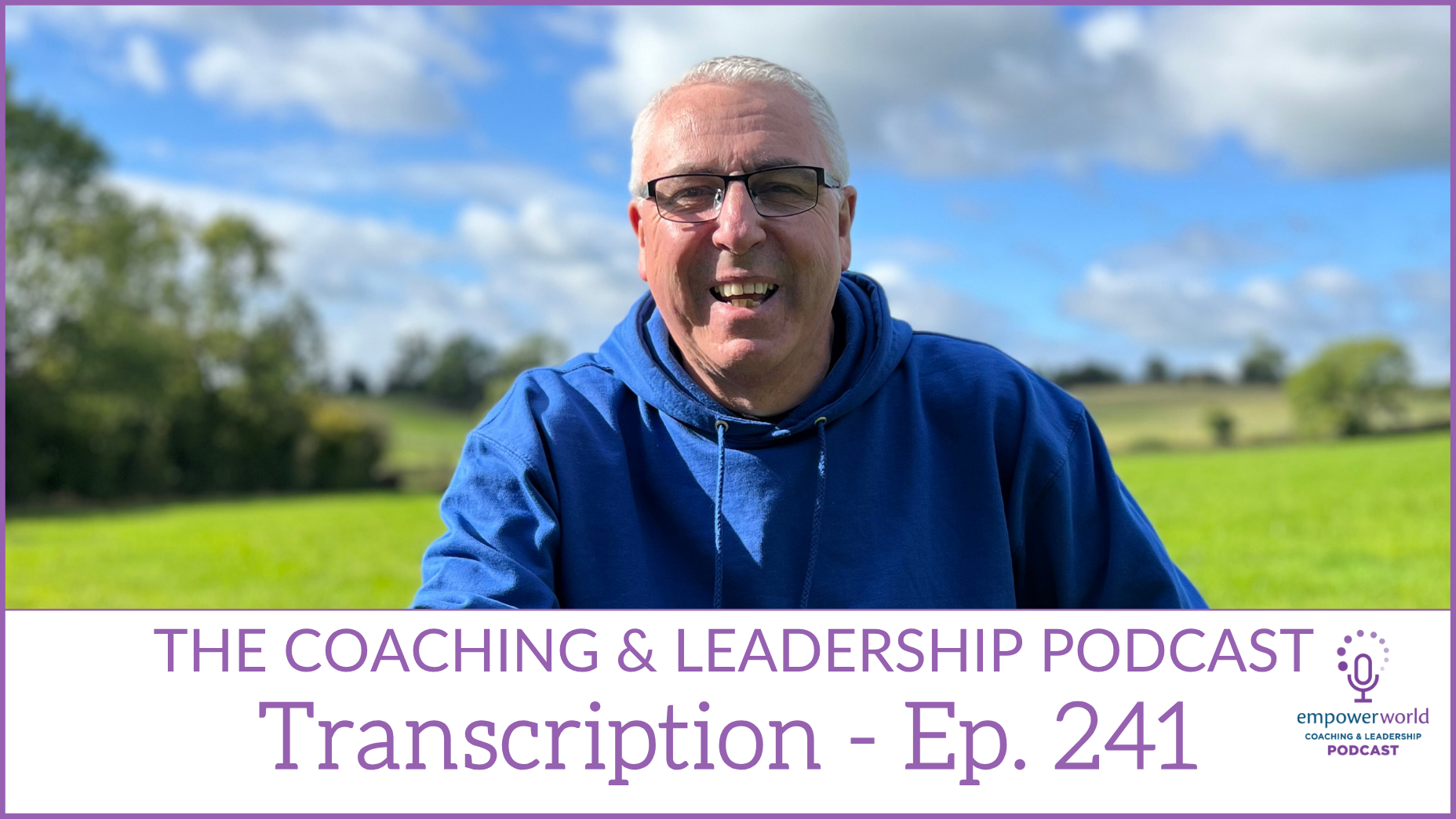
Paul Jefferies
An Executive & Team Coach
Jeanine Bailey: Hello, and welcome to the next episode of the Empower World Coaching and Leadership Podcast. And today, I'm without Marie, but I am with Paul Jefferies, a wonderful coach who I met recently on the Association for Coaching Global Coaching Outdoors Conference, which I believe was, was quite, new and refreshing for the industry. So, if not, it was the first time that anything like that has happened, so I really enjoyed being a part of that conference, as I do feel so, so connected to nature in so many different ways. And so, it was a delight to be an attendee in that conference, and I also attended Paul's session in relation to team coaching in nature. And as a coach, I really appreciated what Paul brought in, his wisdom. And, and what I learned from that session, so I, I thought to myself, I must, I must ask Paul to come on to our podcast. So, so welcome, Paul. Thank you for saying yes, and thank you for your time. I know it's a busy time for you, organizing Another, conference or training in relation to, outdoor.
Paul Jefferies: Yeah, thank you so much, Janine. It's been, it's just lovely to be here, and thank you very much for the very warm welcome, and and it was, I mean, just to say the AC conference was, Fantastic, and it was really lovely that, you attended, and you've invited me on today. It was the first, for, you know, AC to do the conference, and, you know, very big shout out to the AC for doing that, along with, Anna Marie Watson, who was partly involved and instrumental in putting some of that together, so big shout out to those two. And, you know, it may seem odd that there is a nature-connected conference online, but it has reach, and so we're able, you know, through that, as outdoor practitioners, to get that reach, and so, yeah, it's fantastic. And I'll talk about the other event that we organize an in-person event coming up next year, and I'll mention that maybe towards later. But it’s wonderful to be here and have the opportunity to talk about team coaching, you know, in nature and with nature. It's so important, you know, again, a bit of, you know, the background of, nature is part of us. We are part of nature, and it's a really important point that I would, Want to get the listeners to, understand, and it comes out in teams, you know, this part of being in the system, and the system is part of us, and this, lovely image that we get, that we mustn't see ourselves in this, I'm afraid to say a very increasingly disconnected world, and it's, you know, we're trying to reconnect here, and we'll explore this through the conversation, that reconnecting with the system and nature is important. And I suppose I should say a bit about my background, which is, you know, I've been a coaching practitioner now for 7 years. I had over 30 years in corporate industry, so in various roles, you know, so I was, I've worked in the manufacturing, operational sector, food, pharmaceutical, packaging, paper, but, you know, and mainly in, you know, directorship roles, divisional roles. always leading teams, so that's the connection. With a coaching style and leadership, I think it's true to say, as many of your listeners will know, and are similar to me. Probably didn't realize at times what I was doing with coaching, but laterally, I then left. The corporate world, and retrained and got my professional, credentials and training and so on, started with Henley Business School, did my PCIC, and then I laterally went on, and I was the one of the first members on the team, board, and systemic coaching course at Henley. So there were 12 of us in the very original cohort, and that's going back about 3 years, nearly 4 years ago. And it came alive for me. Teams have been an important part in my life and my career. I've always led teams, And, you know, even going back to a child, I, I always seemed to be the one who was organizing my friends and my neighbours into things and stuff, and I even have very happy memories of being part of that, and I suppose that, you know, really connects for me. And lastly, always being in nature, I grew up in the Cotswolds. I spent a lot of time outdoors. You must remember, I'm, I'm 57, I'm a, I'm a child of the 70s before the technological revolution, so I had many, many happy hours building dens, running around the fields. Nature was very much part of my upbringing, and I had huge connections through it, through playing, through being with it. You know, and animals, and plants, and so on and so forth. It was a very lovely upbringing in that sense. And I think the other thing that listeners, just to connect a little bit with me and my background, is I'm the eldest son of a blind mother. So, I had a lot of responsibility. My father was building a business and was very busy, and, but I spent a lot of time as being the eldest and with my mum, and so, Sometimes when my mum was okay, and everything was good, and she was happy and comfortable within our home, I could go out, and I could release and be in the fields with my friends, and so nature was a very secure, comforting, and freedom for me. I could be myself, and, these are important shares just to understand, perhaps, how I've ended up in team coaching. So, so yeah, you know, Laterally, I did an MBA at Henley as well, so, you know, I've done those professional credentialing and qualifications, and then many years of experience, which has got me to here today.
Jeanine Bailey: Wow, Paul, what a, what an incredible background, and It's, it's inspiring to hear, you know, what, what is your, Your grounding, what, what inspires you? Your experience, and certainly your passion comes through loud and clear in terms of where you are today, and what you do, and how you connect that to nature. And as you were sharing that, I was just also reflecting upon my own experience, which was very different from yours, in that I was a city girl through and through for a few decades. And, But I enjoyed traveling, you know, I started traveling in my 20s and 30s, and I really, appreciated, nature, and I have a creative streak within me. I like to paint, I like to photograph, so, so nature has always, not always, but for a very, very, very long time been a, A strong passion of mine, but,
Paul Jefferies: Lovely.
Jeanine Bailey: In later decades, I have really been drawn to the country, the countryside, and being immersed in nature, no matter how small, or how big, or vast that is, I know that's, I know that's my happy place. I know that's, where I connect, and as you shared, Paul, in these times, in these very, very challenging times, I think. Reconnecting with nature just helps to ground, certainly for me, helps me to,
Paul Jefferies: Absolutely, yeah, yeah.
Jeanine Bailey: Appreciate the world.
Paul Jefferies: Oh, that's lovely. Thank you, that's a lovely share, thank you. Yeah, it's brilliant, and I totally get it. It's, and many people do. And look, there's no right or wrong. I've met people who have lived with nature all their lives, I work with people in the farming community, people who are nature-based, and then I've met people who have only come to nature in, their 50s, or, So, you know, it is about just touching and, you know, reconnecting, and there are so many things that take us away from the system and from nature. So, yeah, it's lovely, lovely to hear.
Jeanine Bailey: Yes. Well, I had quite a bit of a technology challenge day yesterday, Paul. It was, incredibly frustrating. I've recently been, hacked in my LinkedIn profile, so I was.
Paul Jefferies: Yes, yes, it's,
Jeanine Bailey: dismissed, so to speak, by LinkedIn. So, and various other things were happening. So I just thought, I've got to go, I've got to get out into nature, I've got to go for a walk, I've got to see those horses up the road, and just walk through muddy fields and,
Paul Jefferies: Absolutely. Yeah, which was, Good for you.
Jeanine Bailey: It was.
Paul Jefferies: Yes, absolutely.
Jeanine Bailey: It was a good thing to do. And like you said, Paul, a big shout out to the Association for Coaching to make that conference happen, and I'm hoping Anna Marie will also be a guest in the near future as well, so,
Paul Jefferies: Yeah, she's, she's great, yeah. Yeah, brilliant.
Jeanine Bailey: Having reached out to her, too.
Paul Jefferies: Good.
Jeanine Bailey: Yeah, so, so Paul. What do you believe first drew you in? Because you studied as a coach, and certainly you had that connection to nature, but what, what brought those two things together for you? Yeah, so, say more about that.
Paul Jefferies: Yeah, no, I mean, it's a great question. I guess, The thing I would call out for listeners is that team coaching is dynamic. It is messy. And, it's challenging work, you know, and I started coaching one-to-one, doing a lot of outdoor one-to-one coaching. I, I, most, a lot of my work is in person still. I do some online stuff, but I still believe in the power of connection and being in the system with my, with my coachees clients. But Increasingly. the draw, I suppose, of 30 years of working in corporate, always working in teams, I'm a high collaborator, I'm high empathizer, and I'd had, you know, we have to be clear, I'd had 30 years of immersion of being in a team, of a manufacturing team, a sales team, a leadership team. And so, it wasn't really much of a stretch for me to, first of all, craft my practice outdoors one-to-one, and perhaps we'll talk about the practicalities of how I made that transition in a bit, but the team stuff really was not far away, and when Henley approached, and I saw that they were doing this first cohort, for team coaching and board and systemic thinking. I, I, I just jumped at the chance, and I was lucky too, the lecturers were Paul Barber and Lucy Widerson, who are just fabulous people, I would call them out. as amazing, both coaches and lecturers and team coaches, and they've written, they're in the second edition of their book, Team Performance, which is a wonderful book. And I worked, you know, on that, did that, and it really sparked a real energy in me around, this is what I want to do, I enjoy this, but I'm gonna do it outside. And so, the two was just this whole, unison and combining of my love of nature and walking, I've always loved walking, and teams, and corporate teams, and, So, I, I started to create days, sessions, and, you know, how that might look for a team and stuff. So, I took a lot of the learning from, shall we say, the classic kind of team coaching models, which we can unpack a little, but then I kind of brought that out into what that means, being outdoors, and the benefits. And it was very clear very early on that, you know, the systemic side of being outdoors really helps connect teams, around that stakeholder thinking, being part of the wider system. So, you know, my approach to team coaching does tend to work on leader, so I will work invariably with the CEO, then I will work with the C-suite, and then we will work with the organization, and we, so we sort of almost unpack and come out. So again, we're working on that system. Making sure we've got that leadership, sort of, you know, clear, then the wider, sort of, deployment, and then we ultimately move out into the wider team, so, The first thing to say is all of my team coaching outdoor contracting I really don't do anything with a client that's less than 6 months, if I'm, you know, you're going on a journey. This is a really crucial part for the listeners to understand, is Group coaching, as we all know, is a one-off intervention, it might be half a day, of a group of people that haven't known each other and don't work together as such. So, just to be clear, we're working here with a team who are a team, a true team. They have purpose, and that's something we'll come to. I will look to find out what that purpose is, and we might collaborate and coach and work together on finding out. Some know, some don't. And then we're, we're a true team around And this is important, again, the practicalities of working outdoors. I really don't tend to work with teams much more than 10 or 12 outdoors. I mean, that's really the limit. There's a number of reasons for that, and I might co-coach as well. I might bring in other people to work with me, which I do for slightly of those larger teams. Simply, noise doesn't travel very well if you're outdoors. You need to be in some close-ish proximity. And ultimately, you know, you've got to get yourself around those people, etc, and feel that there's quality within the coaching. So, my point here is just be very clear about the size of the group. Ideally, 6 to 8 people are almost perfectly ideal. And, you know, you're going on a journey. You're signing a contract, you're working with this team in interventions. Initially, it's always quite high. There's a lot of intervention. You might be doing some, Stakeholder analysis, team of teams, we're looking for where are the dynamics, what individuals might be experiencing, within that team. And then we're, we're kind of then tailing that off, and so this might be a one-day session in, in, I find locations. I would encourage the listeners to, Find a location that's, you know, you've got to hold psychological safety, you've got to hold some, you know, you know, confidentiality. Parks and certain places are okay, but you've just got to be very careful. You're in a corner, quietly somewhere, you know, I have had people, I mean, you know, I'm just going to share warts and all, where I've worked outdoors in a park and a member of the public has gone, oh, there's a group of people over there, and they've walked over and stood on the edge and looked in, and it's a bit like, oh, hang on. So, you know. I've seen a lot of it, there isn't much I haven't seen. So I tend to find locations, or a private owner. Mate, I have a beautiful, stately home here. which is used for weddings at weekends, but it doesn't get used in the week, and so I make use of it, and the owner is able to make some revenue. So, you know, there's always lovely little places to find if you can. Where you can bring a team, you've got some facilities to use, and, you know, you're making sure that it's comfortable, confidential, and it's feeling safe. And you, if it's got some variety in the nature, you can move through a wood, maybe out into a lawned area, there's a pond. Have a look at the variety of the nature where you might be working. That can be really useful for metaphor and mirroring with the team. So, we will then go through a series of interventions. around a day, half a day, with a team, and we may well be working individually, and then back as a group, or back as a team, and we're moving through that. And really what we're doing is, is we're getting them to really ground themselves back in nature. it, there's less distraction. You know, I, I know when I was, talk, we last, when I was speaking with you, Janine, on AC, is that there's, the boardroom is called the boardroom because it's boring, and I always have this saying, chief executives will go to the window. If you think about it yourself, or any of the listeners. When you're looking for inspiration, or you're feeling a little hemmed in, and you feel like you need to be creative, where do you go? You will invariably go to a window, and you will look out. And, I want to sort of, I suppose, say to people, if you're really interested in this, invite your clients to come out through the window. That's really what you're doing. You're a catalyst, you're a lightning rod to say. Why don't you come with me? Why don't we actually take you and your team, and let's go outside, and let's ground and connect? So, there's less distraction, They're not, you know, It never ceases to amaze me, Janine, that people will sit in the same seat in the boardroom, week after week after week. It's incredible. And it's comfortable, it feels, you know, safe and secure. And so what we do is, if we really think about it. We're taking them into a new environment, and that can give more creativity and more expense to their, they relax. There is, through Kaplan, through Wilson, there's lots of science, attention restoration theory, and again, these are really, if you're really into that, the science, have a look up Kaplan and Kaplan, Wilson. They're, you know, it's restorative, so people tend to relax outdoors, it feels less formal, you know, you might be walking in a group, side by side. You know, you're doing, You know, a lot more activities that feel experiential, so people are feeling a little bit more like, you know, and there's the blue-green psychology, people are relaxing, and so, We really find those benefits really kick in here with Teams, and because it's different, people are a little bit more open to try experience. And you can introduce different workshops and activities to stretch, and you're trying to build insight and, you know, new, new perspectives, new ways that the team may have understood. Some of those techniques I'm using are still classic coaching techniques, Constellation, Geschult, facilitative-type techniques, but what we're doing is we're using with and in nature. We're not being extractive. Whatever shows up in nature, we may That might be a good metaphor, or a mirror. Or it may not. But ultimately, it's there, it's a partner.
Jeanine Bailey: Hmm. Fantastic, fantastic, Paul. And, you know, the, I had so many questions. I think, I think you've potentially answered a lot of those questions, as you've shared, really, again, so generously about your experience of working with teams in nature. And, one of the things I was going to ask you about is, you know, what is it that you do see that, you know, that really makes the difference when you are in nature that supports the teams, and you've explained that too.
Paul Jefferies: Mmm, yep.
Jeanine Bailey: And so I'm wondering whether, in your experience then, if there have been times when perhaps individuals haven't felt comfortable in nature, or perhaps something has happened, perhaps a freak storm has moved in, or, or it's perhaps turned chilly, which can make people feel uncomfortable. I'm wondering, again, for the audience who might be thinking the same thing, how have you worked around those kind of, Curveballs that might happen.
Paul Jefferies: It's a great question, and and obviously. you know, we've got to sort of think as well about this is, you know, we're going out globally here to listeners, environment, you know, different countries. So, you know, contracting here, is incredibly important. And so, knowing, you know, your environment, where you're going to go. is really important, the practicalities of team coaches going outdoors. So, first of all, a risk assessment, know the location, understand that we're going into a dynamic environment, the weather changes, things change. So. Knowing that you've got a dry weather alternative. So that might even be, there is a marquee, a room, or somewhere, a stable block. I think I've used all of these.
Jeanine Bailey: In some form or another.
Paul Jefferies: I have sat with a team in a unused, disused stable block, having some bacon sandwiches in the morning and cups of coffee while we retire from the rain. And, but I still make use of that space, so, We may be having an informal, you know, food and some coffee, but we might still be continuing a group discussion, but we're in the dry. There really is no such thing as bad weather to a point, but there is bad clothing, so, We do contract very heavily to ensure that our teams understand that, you know, this is the kind of the kit list that you may want to bring for the day, or the half day, or whatever. Understanding that closer to the time as a team coach, I will give you updates. So, sometimes I get the team on a WhatsApp group, and I might just look at the weather and say, okay, we're looking good for tomorrow morning. So, actually, I think we're okay for, sort of, sweatshirts and trainers, or walking boots and, or we might need wet weather gear. So. It's understanding the ability and the level of your engagement of what that team is prepared to, you know, engage with. So I've had some teams who want to do something far more adventurous in terms of a walk, so we do walking and coaching, we might head off into what is the peak district, it's much more exposed, and so therefore I'm taking the responsibility You know, very clearly. So, first of all, I'm a qualified outdoor first aider. So, this is something I would also, you know, again, draw our listeners to. So I do a 16-hour, 2-day, full-blown first aid course where I'm qualified to deal with stuff out on the hill, or the outside. I'm a mental health first aider, and I have my insurance. also takes control over the fact that I'm going outdoors, and I'm kind of with a group outdoors, etc. So, again, look at the public liability, look at those aspects as well. They're very important things to, Have I done a coaching? Yes, I remember standing with a young lady, in the Peak District. It rained, somebody may as well have been pouring buckets on us. It was that bad. And of course, it turned inclement very quickly, and I asked the coachee, would they prefer we head back to the car, and we call it a day? And this coachee was, no, let's find a dry spot under a tree, and we sat under a tree, and we carried on coaching, with the rain pouring. I mean, literally. you know, we got caught out that day, the weather turned quickly, but, you know, all the time I'm looking and checking about, like, how's the coachee feeling?
Jeanine Bailey: It does happen.
Paul Jefferies: And then I've had glorious sunshine, where it can become very warm, and you've got to then be aware that, have you brought a sun hat? Have you got sun cream? Have you, you know, So, we're really sort of taking the coaching, both physically, I mean, it is somatic, we're working head, body, and soul. But we've got to also take some responsibility as the team coach for people's comfort. So those are some of the things, I would say, the practicalities of, you know, what we're doing here. And of course, you know, making sure that we find an area that's interesting, and the nature itself is useful, you know, can be really important. So there's not distraction. We want an area where we can focus on the team, but we don't want someone in the team so distracted that they're looking off or away, and they're not engaged. So, it's a dynamic environment, and You've really got to do your homework, and rec-y the area, maybe understand. But equally, that rec-seeing can be positive, because you may be drawn to something that you think, this could be really useful in my workshop. in eliciting some metaphor, or some mirroring, or this is a really lovely walk, or, So, it's a positive and a negative. You're thinking of what could happen, but you're also thinking of all the great stuff that you could use.
Jeanine Bailey: Mmm, yes, absolutely. And, Paul, I wonder if there's any kind of, example that you could share with our listeners that really demonstrates that The power of team coaching in nature.
Paul Jefferies: something.
Jeanine Bailey: brief, and something, of course, I know it will be confidential for those involved.
Paul Jefferies: Yeah, absolutely. Yeah, so I think one of the night, one of the things I would, encourage listeners to try is, I use a lot of constellation, work. It works extremely well, as many of the listeners will know. Constellation work, you know, coming from, John Whittington, or even back earlier, to family constellation used within, family, you know, therapy. And, you know, I'm particularly interested in that. I do a lot of constellation in my working week and months, and so, I, I have a beautiful one, which I'm very happy to share in the sense, so we explore a waterside lodge. And a typical exercise may be that we have a team who come along to my waterside lodge, I invite them to come in, and we have a, we have an inlet that comes from the lake, and we have deep end, we have a shallow end, we have a diving board, we have a lifeguards chair. And, You know, we've got all of these things, we've got a spectator area, and first of all, I asked the team just to walk around the constellation, moving through these areas, just listening to both their, their body, and their heart, their head, but also nature. And just notice in themselves. First of all, when they move into these areas, the deep end, the shallow end, the lifeguard, what are they noticing in themselves? And what are they beginning to notice about their inner nature and the outward nature? So both, inner and outward. And then I invite them to go and stand in my Waterside lodge, in the area that they feel represents them within the team at this moment in time. So I've had people who are, they end up on the dive, diving board, Janine, and they're, people become very somatic and very, almost quite theatrical. You know, I'm diving in, they're going. And when we, we invite them to explain why they've placed themselves. So I'm coaching here, and I'm inviting them to share with their members of the team. Oh, I'm here, they say, because, I'm about to dive into this huge project, and, you know, globally, I've been invited to lead this project, but I'm feeling a little unsecure, a bit insecure, I'm not sure, I've got a lot of responsibility. And other people place themselves in the shallow end. I'm feeling quite comfortable. I'm, you know, and other members of the team, I invite them to ask questions of each other. So I might then say, somebody might say, as an example. Oh, I can see you're comfortable in the shallow end. I wonder what it would take to invite you down to the deep end to help us, or,
Jeanine Bailey: And,
Paul Jefferies: I'm now just holding space. Now the team have now taken over the coaching, so we're coaching each other here now, and all I'm doing is, I'm holding space, and I'm encouraging, and I'm offering and eliciting insight. Sometimes the lifeguard's chair is a very interesting one. It's probably one of the least popular in this particular exercise outdoors. Because some people see it as a little bit authoritarian. I'm the, I'm the bookkeeper, the, the quality, or the accountant, or, but it can be even very important in a team, this role of, you know, I'm kind of making sure we're all okay, we've got good governance, we're making sure that everyone in the pool and the waterside lodge is safe and secure. And so you get these lovely metaphors, and But people start to talk about the trees, they talk about, oh, this bird flew by, or a water, something went down the water, and, it just gets some beautiful metaphor, and so what I'm doing is I'm getting them to explore their inner nature, themselves. Why did you place yourself here? But then we start to see them exploring their outer dynamics, the, my relationship with Janine, my relationship with Harry, my relationship with Yvonne, or whatever. And then we might even, talk about Who's not here in the team? What, and to be fair, people have said, well, the board members are not here, the trustees are not here. So I find something, could we choose something that could represent them? And they might choose a leaf, or a twig, or a stone, or, and we talk about, then, the trustees, and we say, well, okay, well. Where would they be if they were in this waterside lodge, and they placed them in the deep end, or the, you know, it's incredible. And so much so, one day, I was doing a constellation Outdoors, and, I placed something in the middle, a value. I was getting the team to explore values. And I placed a value in the middle of this constellation. And one member, I can't tell you, he will virtually say, Janine, he left the area.
Jeanine Bailey: Hmm.
Paul Jefferies: He walked so far away from this value, he was almost on the other side of this, field. So, I said, come on, team, we've all got to head over and go and speak to, you know, the member. why they've gone over there, and when we got over there. they were very clear and honest. They said, I'm, that value is so abhorrent to me. this organization has never lived that value, and I cannot understand why you, as the rest of the team, are so close to it. For me, if I could get to the next field, I would be in it. And he was really, And it elicited this amazing conversation within this team. No one knew he felt like that. He had not declared it, but on this day, we'd created a space where he felt comfortable enough to share. He did, and it absolutely opened up some incredible thinking for this group, and they were able to then move through that. And it's that power of being outdoors in a more connected space, relaxed. And, you know, we explored with him later why he felt he was able to do that, and he said, I felt like this was the space, this was the time that I could do it, and it needed to be said, and That, for them as a team, is incredibly moving. For you as a coach, you feel very much part of, it's about being in the moment with them, and reading, and being very present, but I find in constellation work outdoors that that becomes very, easier. I feel as a coach, Janine, that's where I do my best work, when I'm outdoors, you know? I feel alive, and I feel connected to the system when I'm in that type of constellation environment. So I hope that answers your question as an example for you and the listeners.
Jeanine Bailey: Yes, it really does, Paul. Thank you for really bringing that the power of nature and team coaching alive with that example, and what I was hearing was that Incredible ability for that particular person to somatically express themselves.
Paul Jefferies: Exactly, yeah.
Jeanine Bailey: Which, as we know as coaches, is incredibly powerful. So, you know, I'm hearing all sorts of things that we're coming together here, that somatic response, but also connected to nature. And in that safe, safe container that you've created in nature to be able to express themselves.
Paul Jefferies: Yeah.
Jeanine Bailey: freely as they did, and powerfully as they did. Yeah. Yeah.
Paul Jefferies: Yeah. Yeah, and it is that, the power of that work, and again, always, I'm always unsure, we're never extractive from nature, we're always within, respectful of it, and, you know, that's why I always say, use the language of, we are, We are working with and in, and we're part of nature. So, you know, my aim is always to leave the lightest touch. You know, for me and the team, we've been, we've arrived, but we kind of leave, and there's, nature has, you know, supported us beautifully, but we've not, And so, you know, those are just, you know, some really nice things. And some of the other examples, we might do solo walks, we might do walking in pairs. And again, there's deliberacy as a team coach. We may put, you know, perhaps you and I within a team, we're struggling with our own personal relationship between the two of us. Perhaps we're working on, you know, let's give a real example. We may have some I'm always looking for collective goals in a team. But you and I may have juxtaposition, you know, and we're not, our KPIs, our goals are driving us, we're not quite aligned, and therefore we're a little bit, So I might deliberately put us in a pair, and walk, And I pair the group up, and we walk, and I move from those pairs, allowing them to have conversations in nature. And so, you know, there can be real deliberacy in team coaching outdoors. So, somebody may need to walk on their own, we may walk as a group, or we may walk as a triad, or as, you know. obviously, I'm holding space, I'm holding the, you know, that safely. And so, you know, those are the, you know, wonderful things that, you know, we're trying to use and, bring together. So, and a lot of this is based around, you know, clubs, experiential-type work. We're offering a concrete experience outdoors. We then reflect, we think about what that may, and then we open up new insight, and then we might move that into an active, you know, trying something, and we constantly go around that circle of, But your opportunity to be experiential outdoors is, phenomenal. You, you know, yes, you can do that in a room, in a boardroom, I'm not suggesting you can't. But there's a lot, there's a lot of, outdoors brings that really alive, and you can really work with that. So, yeah, it's those sorts of techniques. I've even sat, I have a one, I call it, Supportive Gossiping is the name of the title. So we place one chair in front of the horizon, we look for a vista at the location. And we have a chair on the lawn, and then we have the rest of the team sit behind. So one person, they take it in turns, sits looking at the vista with their back to the rest of the team. And the rest of the team are invited to see and find something in the vista, in front of them. And find a metaphor that describes their colleague that has their back to them. And you, it's incredible, the power of watching somebody say, I'm looking at the sun, it's shining so brightly, but that's because that's what you are. You shine so much in this team. Your energy, your brightness, it, It lightens my day, it helps me get through projects. You know, and people just find the most beautiful metaphor and mirroring to talk about a colleague. And I've had colleagues turn. I invite them, all they can say is thank you, so they turn, they look at the group, and they say thank you. We don't, you know, elaborate or offer comment, but I've had people turn with tears down their eyes. I mean, it's, you know, so these are really lovely. Very simple bringing nature into the conversation, and it can be quite magical, and really helps them to get a new perspective.
Jeanine Bailey: Yeah. How, how beautiful. I actually feel a bit emotional myself, as I, I, I, you know, I really appreciate the powerful work that you are doing, and, And again, really supporting people to reconnect with Our planet.
Paul Jefferies: Yeah, yeah, it's important, isn't it? Yeah. In this meta-crisis, and I, I, you know, I had an interesting discussion with somebody recently about, you know, as coaches, remember we're coaching and contracting, so we're not bringing it in as a bias. The contracting is really important, so when people are approaching me as a team coach outdoors. I'm, I'm offering and being very open to say, I work outdoors, but I can work indoors. So, it's client-focused. we're not introducing a bias here, we're saying, well, we must work outdoors, you know, no, no, that's, so sometimes I just want the listeners to understand, I might work indoors near a very big window where nature's only through the window. it isn't always necessarily the client or my preference, but that's not what it's about. It's about what the client needs in that moment. So, you know, nature is there, it can be accessed, and, you know, I just, you know, I do do some of my team coaching as well, you know. in a marquee, or a room, or somewhere, because the weather is not suitable to be out, or whatever. So, You know, it's important, as you say, to understand that you know, these things are there to be used, but we're not trying to introduce a bias or forcing something onto some team that isn't required, you know? So it's very much being, In the moment, listening and reading the system and what's needed for that team.
Jeanine Bailey: Yeah. And I think also being very creative. You know, when we are indoors, a lot of my, coaching in the past has been in Qatar in the Middle East, which is a desert, so,
Paul Jefferies: Try getting out in that heat. Yes. Yes, exactly.
Jeanine Bailey: In, you know, for many months of the year, it's, it's, it's tricky.
Paul Jefferies: Yeah.
Jeanine Bailey: But certainly, we can, and where I do my, coach training, where Empower World does its coach training, it is in, A room with a massive window which looks out across, across the sea, so you can bring those.
Paul Jefferies: Amazing. Lovely. Yeah.
Jeanine Bailey: And just to say, Jenny, I mean, I have a, I'm aware of,
Paul Jefferies: A coach who is a new coach to outdoor coaching. He works in Dubai, and you'll know. So he works in the evening, and in a conversation, he's working in the shopping mall near huge walls, which Dubai have, of living walls, of plants and fountains. And so, of course, in the evening, the weather, and in the shopping mall, it's comfortable for the client. But he's still using that nature, and the water, and all those lovely metaphors and mirroring And he's doing it there. So, you're absolutely right to bring that whilst here in the UK, we're blessed with a temperate climate. you know, we have to understand that there are people, I know of, outdoor coaches in Scandinavia working in quite cold conditions, We've got Singapore, where the lovely Lisa Partridge, who does her work in Malaysia, you know, it's very humid, and so, You know, we've got to, you know, understand that, you know, nature is many things, and people are doing some incredible things around the globe. around exactly as you say. So, you know, it can be incredibly dynamic as well, so, But, you know, I think the last thing I would think in terms of some of that is, I think it's about being, not just as a coach, the team benefit, but you as a coach, you're, you feel much more alive outdoors, you feel very connected, very grounded. And it is very much able to sort of feel what that team and what the system may need of them, and so it's, I would say there's this word connection, this being, as we call it, the four C's being, this confidence, this courage to try things, feel very connected. And of course. What I also, lastly, would draw the listeners to is. is, nature is regenerative, this concept that is talked a lot about, but, It never ends nature. It renews, it regenerates, so I bring a lot of cycle and cyclical behaviour in. So right now, I might be talking to teams, and I've been working with some just recently around the harvest, the autumn. We've gathered in all this wonderful work that we've done in the summer. the spring. Incredible projects that this particular client has done some amazing stuff, actually, over the last 6 months. But now I'm trying to get them, we're thinking about, and challenging them with questions around, so what are we going to do in the winter? We're going to hunker down, we're going to restore the storage, we're going to replenish. We've got to be ready for another growth spring year, you know? What is it did we learn? You know, winter's a lovely period, as you know, reflective time. So what are we going to take from 25 that we're going to carry on into 26? What is going to die and decay, and we're going to leave it? We don't want to do that. So, there's all these wonderful, you know, and, you know, you can be serious, you know, and look. 7 years ago, 6 years ago, I had chief executive, some of this was, some of them were, oh, you know, I'm really not sure, Paul, about going outside. And, I'm not advocating, necessarily, that I want them to go and hug a tree or anything. I call it, I'm very much an edge walker between economy and ecology. But I can tell you now. more and more teams are walking out, they're getting it, they, for various reasons, and all of them are all good, but people are beginning, teams are beginning to see the benefit of this, and it's becoming a, I think it's going to be a really big, area in the next 5 to 10 years. It's growing, and more serious business corporates are seeing the benefit of this.
Jeanine Bailey: Yes, I, I have to agree, Paul, that it's, it's going to, I believe it's really going to support and take off Duh.
Paul Jefferies: Hmm.
Jeanine Bailey: Again, bringing new perspectives, and you know, with everything that's going on right now, I believe more and more people are becoming more conscious of what's really, truly important.
Paul Jefferies: Yeah. Yeah, and I think, I think I want to sort of, you know, I like technology, I had 30 years in being, you know. what I want to say is, there's a real place here. I get the AI generation. I, look, I'm 57, I'm, I'm becoming an older man here. I'm probably not the best to be talking about AI and, you know. But I get it. And my creativity and my ability to see that vision, I understand that end of the, But there is something that I would draw you, us, and the listeners to, is that, I'm 57, I know how spiritual and restorative being outdoors with, you know, my team, our team, the people I'm working with. And in this disconnected world. I feel like it's important to be with someone in nature, and a team, and experience. And remember, shared experience is another key point here. Teams are leaving a day with these interventions, they've got shared experience. They talk about it. I had a chief executive say to me just recently, Paul, they're still talking about the day that we had outdoors a couple of months ago. And I'm like it, great! That's what we want, you know, and they're sharing those experiences, so, whilst, at the end of the day, there is all this amazing stuff going on with technology, and brilliant hats off to it, I think there is a, a balance in life that we need to strike between the yin and the yang of that, and I think team coaching outdoors really offers something here, and I think that's what's really important for the listeners to understand.
Jeanine Bailey: Mmm, yes, and I couldn't agree more with you there, Paul. I could not, it's, I think it's a really, Important point that you brought in. Because, yes, we can get too addicted to being in front of these screens, which we know, Of course, there are many benefits, but there are, with everything, there's drawbacks as well, so,
Paul Jefferies: And isn't it interesting that those COVID years, they did drive both of these arguments. I mean, you know, I think, famously, Zoom would have it, that Mother Nature sat around that boardroom of Zoom, and probably had the biggest contribution to that company's growth, and it was, and it wasn't, and it wasn't any one member of that board that, but, but Mother Nature, sitting quietly, part of nature. allowed Zoom to suddenly, here we are today, and Zoom just took off. But interestingly, we also needed to get outdoors, and the revolution that that gave us was suddenly everyone decided and realized, oh my gosh, I'm so disconnected.
Jeanine Bailey: And I call it my, I call it,
Paul Jefferies: I even speak to teams when I meet them, Janine. Hermetically sealed Tupperware boxes. Some teams I meet have been living in a hermetically sealed Tupperware box for so long. that they don't even think about stakeholders, the nature, the world, and what's going on for them. So, you know, it drove, that crisis across the world as it was, and a very sad and difficult one for many people. But it drove both of the behaviors that we're discussing. It launched the AI and the online behavior, but it gave and reminded people of something that they'd lost.
Jeanine Bailey: Yeah. And, when, constrained to only being in a, certain, certain perimeter. Yeah. You know, it really, invited people to, go, I want to be out there. I want to have that freedom to go out for a walk in nature, so yes, it's.
Paul Jefferies: Indeed.
Jeanine Bailey: It's really interesting. So, Paul, I really appreciate everything that you've brought in to our podcast today. Your wisdom, your experience, your, your thoughts, and so much more. Really, really appreciate it. And I, we, before we came onto the podcast, you were telling me a little bit about this upcoming conference.
Paul Jefferies: Yeah, yeah, thank you. Yeah, so I'd just, yeah, say to the listeners, if you, If you attended the AC, or you've attended, previous events, we are running again next year. So, I, you know, am leading, for, it's called Nature Connected Coaching Live 2026. We're going into our third year. It's at Henley Business School at the Greenland campus down in Henley. And, it's on the 18th, 19th, and 20th of June next year. Tickets go on sale in a couple of weeks, but you can pre-register. So if you go onto the Henley Business School, there is a, or go onto my LinkedIn site, there's a link. And you can pre-register for tickets. And, it's a two and a half day. in-person event, evening as well, where we have, I think we're now going to be up to nearly 29.30. working practitioners, we've got eco-somatic painting, we've got eco-somatic work, we've got mindfulness, team coaching outdoors, group coaching outdoors, urban coaching outdoors, right through to guest speakers and research. We cover all sorts of topics, so it's an experiential two and a half days, where you can immerse yourself with like-minded people, and if this is of interest to you, go to my LinkedIn site, And, we would love to see you next year, because this is a growing community, and it's, it's doing some really, really good stuff, and, yes, thank you, Janine, for a reminder for about that, but it's, it's, I love it. As you can tell, I'm, very passionate about it, and I'm glad that we're able to build a community here. Across the world, by the way, we had people coming from 9 countries last year. Flying in, all over the world to come together.
Jeanine Bailey: Wow, beautiful. Well, I am going to register myself after this call.
Paul Jefferies: Fantastic.
Jeanine Bailey: So thank you, Paul. And of course, listeners, you can get in contact with Paul. We will, you’ll see with the description of our podcast. Paul's contact details. So, and of course, he's on LinkedIn, which is where I was able to reach out to you, Paul. Yep. Paul, once again, thank you. Thank you, thank you. Really appreciate who you are, and how you show up, and how you share your wisdom, so,
Paul Jefferies: Pleasure, thank you.
Jeanine Bailey: Yeah, it's been a delight, and listeners, if you have got value out of this, and you know people who would also get value, we'd appreciate you sharing this podcast, and of course, getting in contact with Paul. Thank you, Paul. Wonderful session.
Paul Jefferies: Thank you.


