
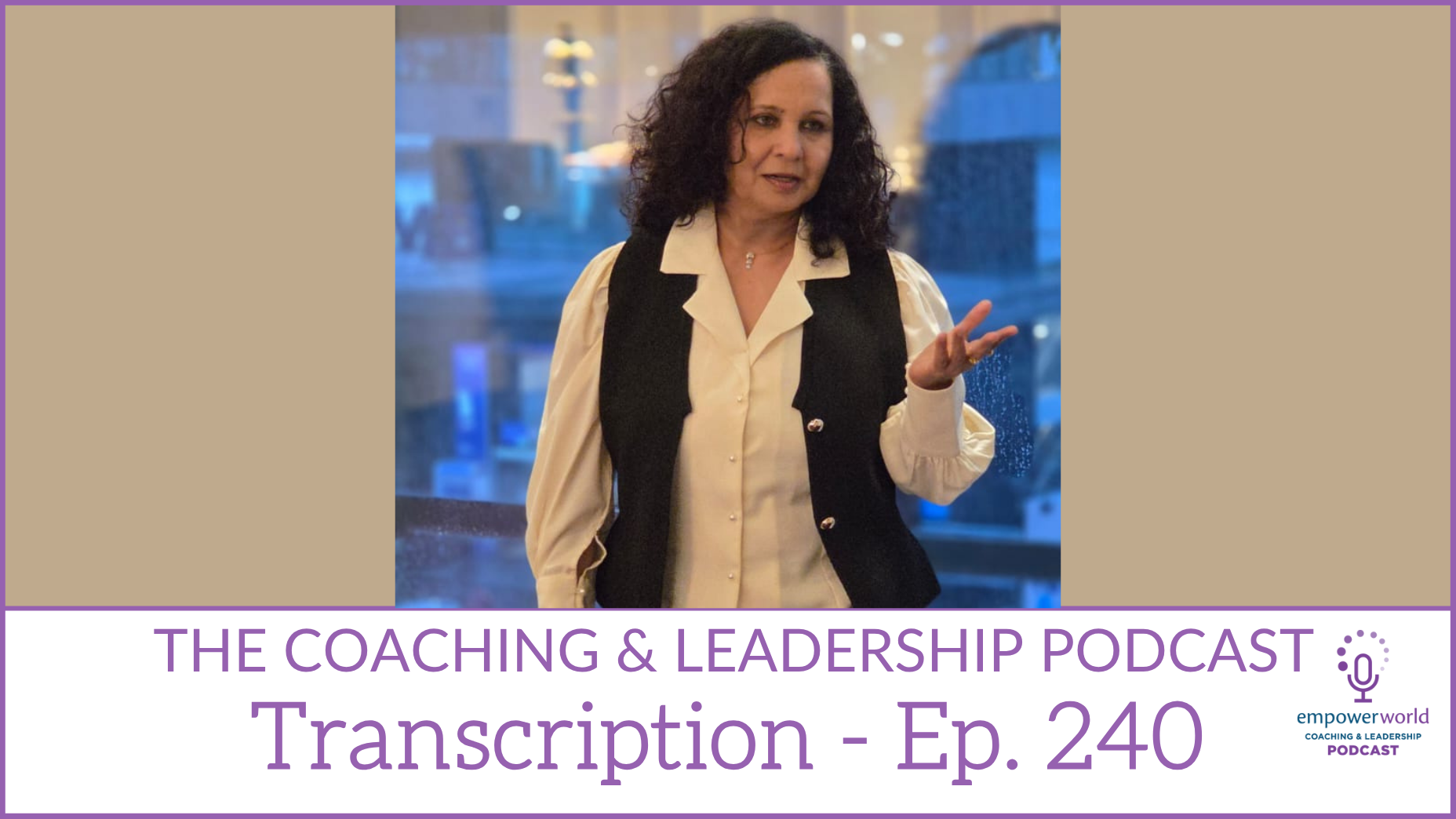
Jayshree Kirtane
ICF Master Certified Coach (MCC)
Jeanine Bailey: Hello and welcome, listeners, to the next episode of the Empower World Coaching and Leadership Podcast. And I'm really super excited to bring our next guest today, who's with me, Jayshree Kirtane. I hope I said that right, Jayshree.
Jayshree Kirtane: Yes, absolutely. Thank you.
Jeanine Bailey: I'm really excited that you're here, because we met quite a few years ago now, I think it was the International Coaching Week. Series of sessions that the ICF Pune chapter put on, and I potentially pronounced Pune incorrectly as well. You can please do let me know what it is. And I was very thrilled to be a part of that, sharing my experience, I believe, with the work that I did with Rachel Patero, and supporting Maori women and Pacifica… Indigenous women to become professional coaches. So… so that was a wonderful experience. And then based on that, you reached out to me to be a guest on your podcast, which I think was something like, Destination vs. Journey. You'll be able to, again, explain what it is when you do your introduction, and that was quite a few years ago as well. But I really, again loved the invitation to share my experiences. And then, of course, just recently, another ICF Pune chapter series called Roots and Wings? And it was about really tapping into the wisdom of the ancient wisdom that we are so lucky to still be connected to, that we can bring into our coaching. It can inform our coaching and inform us going forward. So, that was a wonderful conference to be a part of, and hence my reason for reaching out to you to see what… what your thoughts and ideas could be for our podcast. And of course, we've had a little bit of a conversation, and I appreciate what you want to bring into our session today in relation to the dualities that coaches can experience. So, Jay Sri, I've spoken quite a bit now. I'd love to hand over to you to introduce yourself and correct my pronunciations, if you wouldn't mind. Thank you.
Jayshree Kirtane: Thank you, thank you, Jeanine, for having me on your podcast, which I believe is a highly rated podcast globally. So I feel honored. So, my name is Eshvi Kirtanay, and you pronounced it almost right. So, by education, I'm a mathematical economist. So, proverbial left-brain thinking for the first 10 years of my career. Only logic, only cause and effect, only scientific reasoning. And then, somehow, I think, universe decided for me that I stumble upon a meeting which now I know was called a coaching meeting. I didn't even know that meeting was called a coaching meeting. I stumbled upon that meeting. And in that meeting, I really found an answer to the quest that I had held to my heart for the last 10 years before that, saying, okay, I mean, this is okay, but I don't want to keep doing it for the next 40 years. Then, but what do I want to do for next few years, few decades? And I didn't have an answer to that. So in that meeting, I found that answer. And I asked the coach, who later became my mentor, would you teach me what you are doing? And then he started really mentoring me, first on psychometric assessments, and then facilitation of human processes, and then coaching. So coaching happened organically, for me. I didn't, like, start with an intention to become a coach. Coaching chose me somewhere around the way. So then, all this happened 21 years back. So for last, 21 years, I've been a facilitator. The last 11? Or more years a professional coach.
Jeanine Bailey: Yes, what a wonderful journey, and I didn't know that about you, that you're very much in this sphere of facts, hard data. And it certainly seems, having got to know you, and appreciate how you show up, there's been a wonderful journey that you've been through to what I experience of you coming into your heart and into your body to be able to support yourself and support others. So, I really appreciate you sharing that. And as I reflect that back to you, Jayri, I'm wondering what else might be important to share with our listeners about that journey.
Jayshree Kirtane: Hmm. I think Every stage of coach certification while it came as a credentialing process, I think every stage gave me something. And while I started with every stage saying, I want to create more value for the client. What I actually did was created more value for myself. And then in the process, the clients, I think, benefited and keep benefiting. And of course, Journey Towards Mastery was, I mean, I would, you know, rate that as my… one of the, highest, experiences of Becoming a person. And to quote Carl Rogers, becoming a person, and then, of course, becoming a coach. So I think I've experienced quite a bit of transformation in myself. I can't claim I have transformed too many people, but I can definitely say that I have experienced a lot of transformation in myself, in that journey, in that process. So, and sometimes it may just feel hard. Sometimes it may just feel so, convenient to slip back into the sphere of noon. And into the sphere of very clear, facts, data analysis. But at the same time, I think my, my encouragement to all the new coaches, especially the people who are entering the profession, would be to, you know, to just keep at it. And at some point, it just gets so joyful that you would never, you know, doubt yourself.
Jeanine Bailey: Yes, beautiful. And of course, for our listeners, Jay Shree is a Master Certified Coach. And you were the former, president of the ICF Pune Chapter. Yeah, as well. So, so lots of… you bring lots of experience in terms of Coaching many, many clients, as well as supporting the profession of coaching. And it's wonderful to hear that you have… and I'm making this up, but, you know, really combined Those two parts of yourself. the… the logic… Backside, with the… the heart, intuitive empathic side, and so much more. So, and I guess that leads into what we were talking about earlier this week, and today. The The potential duality of what We as coaches might be experiencing for ourselves, but also noticing in our clients those Those things that can perhaps pull us one way or the other. And potentially finding that balance. So, Jay Sri, I'd love to hear I'd love it if you could share what you were sharing with me in terms of those… and you used a beautiful metaphor as well. So yes, love to hear what your current thinking is all about.
Jayshree Kirtane: Thank you, thanks, Jeanine. And my current thinking and the topic that I would really like to share with you today, has been, you know, kind of a… kind of an essence of what have been thinking, reflecting, questioning, challenging, coming to terms with, for us so many years. So the metaphor, that I like to use is, orange flames and purple flowers. I think meaning thereby, of course, I'm sure each one of our listeners would have a different meaning and a different, perception of orange flames and purple drawers. For me, what it means is the That drive the energy, the assertion, the moving forward, power of the orange flames. And the softness, the elegance, the, dignity, the purity and the vulnerability of the purple flowers. So, you know, these are the two, poles or dichotomies, if you wish. You know, these are the ones that come to be… that came to me, in fact, when I was once, you know, asked by one of my, mentors. So, think about myself, to visualize about myself. And this metaphor came to me for myself, and then I started dwelling over it again and again. And, thing is that, Logically speaking. If purple flowers go very close to orange flames, the flames are going to destroy it, right? And flames may not even care for what was the softness that the purple flowers bring. However, I think metaphorically speaking, I believe as an individual, as a human being, and as a coach. That? It is possible for both these to coexist. And in fact, the coexistence itself makes the world whole. If we had just the flames, the world would be just 50%, and if we had just the purple flowers, it's another 50%. But for us to be whole, for the world to be whole, for our coaches and our coaches to be whole, both these things need to coexist. So that's the, that's the metaphor I would really love to, you know, share with you and her. Lessness.
Jeanine Bailey: Thank you. A beautiful metaphor, and actually, when you shared that, what came up for me was, living in Australia, born in Australia, the threat of bushfires is always a scary one during… during particularly summertime. And you know, what… the damage that the fires can do as a consequence when they come through, for all sorts of different life. But actually, what it also does is it allows the germination of seeds that have laid dormant and regenerate, regenerate the… the Earth, the… you know, what's in the ground, what's ready to come alive. So it reminds me of that, and there's also a practice in parts of Australia where they… they actively burn off the… Every 4 years, they will… Burn off the… the low-lying Grass and scrub. To do just that, to regenerate So that comes to mind. That comes to mind when you share that.
Jayshree Kirtane: Fantastic. Mmm. Wow. In fact, yeah, that reminds me in India, too. I think just before the, new, The new cultivation begins, they deliberately burn the ground.
Jeanine Bailey: Mmm.
Jayshree Kirtane: And it prepares for the new germination.
Jeanine Bailey: Yes, and I did see that recently in South Africa as well, so… so it seems like it's all part of the cycle of life. The ending of something, the regeneration of something. So, Jay Sri, as we journey into these metaphors, what's coming up for you in terms of those… those poles, those polarities? Or geographies? What's been coming up for you?
Jayshree Kirtane: Right. So, I'm sure there are so many applications, and I kind of live it, day-to-day, and I'm sure many of us are seeing it for ourselves, but I think I would just, maybe focus on 3-4 points, which are Which are more relevant, to coaching and to a little bit. Once again, as I mentioned the other day, most of the leaders that I coach are around, you know, in their mid-40s, senior-level leaders who have come there because, you know, because of their technical strengths, mostly. And certain strengths, of course. At the same time, I think what happens during the entire coaching engagement journey is that, they are nushed and encouraged to discover the other side of themselves, which They've just neglected. They've not paid attention to it, and therefore they never knew it existed within them. So I think when I, you know, kind of took stock of about 800, 900 leaders whom I have coached, so far, I realized that this is what, in fact, we are doing through our coaching, that we are Nudging and encouraging and helping, in some way, leaders to really, integrate the dichotomies. balance is a word that, some people like to use. Maybe that's the right word, too. For me, I don't know, because for me, balance means, scale, and where both these things are, you know, equally, balanced. Whereas, in reality, in real life, when we are trying to integrate the two poles of a dichotomy. They never, you know, weigh equally. In some situations, one is required more, and in some other situations, the other is required more. So I would, therefore, like to use the word integration than balance. So, the first and foremost dichotomy that most of us, including me, struggle with is structure and creativity. So people who regard themselves as creative would say, oh, I am such a creative person, I can't fit into the framework. And those who consider themselves as structured people, and structure has given them, of course, success so far, would say. I'm not a creative person. I would rather, you know, go out and hire some creative person from the market. Can't be creative. Even, as coaches, you know, and, because I know only the ICF ecosystem, I do not know the other ecosystems that are also maybe equally good. So if you look at just the ICF, competencies also, if you see, right? I mean, there is definitely a structure. And there's the contract, there is the ethical boundaries. There is a way a conversation is expected to start, and is expected to end, and so on. So, right? There is a… there is definitely a structure. Just because there is a structure, it doesn't mean that the coach Is constricted by the structure. But to my mind, I think when we combine, structure and creativity, we consider the structure as, as guardrails, as our helping frame, which helps us stay in the, in the ethical. And otherwise, boundaries, so that it is ultimately beneficial to the client. within that, it's a… it's a massive playground, and that is where the coach could be, you know, at, his or her creative best. So that's the one, that's one, I think. pair of polls that I, I really encourage coaches to embrace, because mostly people start with, too much leaning towards structure, and then, you know, suddenly the pendulum swings, and they say, okay, you know, let the structure go out of the window. I'm going to be creative. But fact is that only when we bring both together, being… Create the best value. What's named?
Jeanine Bailey: Yes. Yes, beautiful. And, I… yes, I… I absolutely hear what you were sharing earlier about… about balance. And, and from… and I love that you've used the word integrate, and for me, I guess I don't see balances as this. I see potentially someone's balance might… might… I'm moving my hands so that they're not together there. One's up, one's down. That might be someone's balance for them. So, yes, it's finding what, what works, what works for them. And I really appreciate what you've shared about the ICF core competencies, and that's something that we hear quite often as mentors and trainers. There is that leaning to the structure. Or there might be the leaning to. I don't want to, you know, I don't want to do structure. I want to do what comes naturally to me, But yes, when we have that little bit of structure… you know, I really do believe the ICF core competencies have created that scaffolding, or that… those guardrails. That gives us some sort of structure, but at the same time, as you said, lots of freedom to be creative. To really hone into, our own intuition in support of our… in support of our clients, so… Really appreciating what you're sharing here, Jaishri. And I also, heard you mention that the Clients that you work with. And, it's quite typical, isn't it, working with that leadership level. They've been… taught, programmed to. you know, work from… again, I'm just pointing to my head, for those who can't see me versus listening to the… the whole self, working with the… the whole. Side, and then… and then to be able to discover who they really are. Can be so enlightening. When they do that… when they do that work. So, I'm wondering… Jay Sheri, I'm just… I'll just check it. I have got a question, but I'm wondering what might be coming up for you. I just noticed…
Jayshree Kirtane: I was just going to mention another, dichotomy, I know if…
Jeanine Bailey: Yeah.
Jayshree Kirtane: So, just like structure versus creativity, I think another, dichotomy that, always comes up, especially in leadership, conversations, is, Kindness or compassion, versus logic. Once again, people and leaders often think that, if they are logical, then, you know, they can't be kind. And if they are kind, that means they are going away from logic. So, I think that's another dichotomy, and I don't think… These are two things that cannot coexist together. In fact, I guess kindness as a… as a… as a base for all the interactions, if it exists, and if it runs through your veins in your conversations, in your thoughts, then, whatever your logic dictates, kindness would any which way be interwoven into that. You don't have to think separately. You know, should I be kind to this person? This moment requires kindness from me. I think kindness is not something that we need to, you know, really think about and take decisions about. That's Of course, that's my, belief, that it… it is something that is like a… that's like aligning to a… To a silk fabric. It just… it just strengthens, and, it just makes anything last longer.
Jeanine Bailey: Yes, absolutely. And I, you know, what came up for me as you were sharing is that, you know, often our clients and ourselves, of course, because we're human, we make up these rules. If there's this, then this happens. Or if I'm that, then I can't be that. So there are often rules that our clients ourselves will make up. So, as coaches and leaders, we want to support our clients, our team members to look at, is that really true? Is it black and white? That happens, that happens. Or if I… if I'm that, I can't be that. And so we want to, as coaches, support the people and leaders. We want to support the people that we're working with to be able to look at different perspectives and identify What could… coexist, what could integrate? how that could be integrated, so… I'm wondering, Jayshree, I don't know if it's an example or, thoughts in terms of how you support leaders to Integrate those… those rules that they make up. Or those beliefs that they… that they hold. Love to hear your wisdom.
Jayshree Kirtane: Well, when somebody uses the word wisdom, I feel like a banyan tree, so… But, yeah, I think one of the things, as you said, right, I think, just asking these, questions, and, Creating that space for them to explore whether there is anything Other than they already know of. So, that is one. The other thing that I have also observed, and of course that is in my, limited experience, but what I have also observed is people also create, specific personas for specific spaces. So, they have created a persona for their workplace. But it doesn't mean that that's the same persona that they carry in their biker's group, or at home, or with their parents. And therefore, sometimes, integration of some of these thinking patterns Also, you know, finally goes down the path of, integrating the various personas. So, you know, a question about, you know, what other personas do they also carry in other spaces? That question also helps. And third, you know, the other thing, Jillian, that I've also, observed is, presence is what we all talk about, right? And during any coaching conversation or coaching-related conversation, the word presence always comes up. And that's similarly a nebulous word. Most people can talk about presence, but it is very difficult to really say, oh, you do this, and then you achieve presence. Right? So similarly, I think the leaders, although they may or may not be coaches or coaching leaders, I think presence is the important thing. It's just because they are not in the present moment with the other person, they're unable to choose wisely, or they're unable to integrate wisely. capacity to integrate is within us. What stops us from integration is our fear of… if I say this, what might be the consequences? Or our past experiences. So, because we let our past experiences or our anxiety about future meddle with our present moment. We don't allow ourselves to integrate. So another way of, I think, working is, you know, just… Just helping them attain their own, Presence.
Jeanine Bailey: Yeah, yes. And what I'm appreciating is helping them develop that in the present moment.
Jayshree Kirtane: Yes.
Jeanine Bailey: Versus Going into the past which is, you know. who they were in the past, very different to who they are right right now in the present moment. And, and Being in the present versus Wishing about what the future might look like. I think… I think that's really, really powerful when we work with our clients in the present moment to And with that principle that our clients are naturally creative, resourceful, and whole.
Jayshree Kirtane: Yes.
Jeanine Bailey: But they have the answers. Yeah.
Jayshree Kirtane: Absolutely.
Jeanine Bailey: Yeah.
Jayshree Kirtane: You've… you've rephrased what I said so well.
Jeanine Bailey: Thank you. Well, I'm just feeding off what you've been sharing with me, and but I also appreciate how you've brought in how we can put on these different faces for different parts of our life. Again, creating rules that we must be a certain person in a certain… in a certain part of what we're… we're… we're doing, being, to be able to be successful, so… So really supporting our clients to understand Who we authentically are, I'm… I'm trusting. Can support our clients to then decide who they want to be in those different areas of their life that is authentic to them. That is… that is their strength. So that… And yes, I appreciate that, you know, we do want to make some adjustments, but we want to bring in our essence, our authenticity, our strengths, our passion in every part of our life, I believe. To feel home.
Jayshree Kirtane: What's it with him? Please.
Jeanine Bailey: Hmm.
Jayshree Kirtane: Makes it so easy. Yes.
Jeanine Bailey: And so… so what I'm hearing, Jay Sri, is… Supporting our clients to understand, again, their rules, their beliefs about who they believe they should be. I'm putting should in inverted commas.
Jayshree Kirtane: So that they can make authentic choices and integrate. Yes. Yes, absolutely.
Jeanine Bailey: And so I think part of our role as a coach is reflecting back the rules, the beliefs that our clients are sharing with us, holding… being the mirror and reflecting that back. So that they can make choices that are… Their truth, based on their truth.
Jayshree Kirtane: Agreed.
Jeanine Bailey: So, and again, what I'm gleaning from you, Jayri, is really helping our clients understand those polarities. That our clients ourselves will experience, so that they can Perhaps those truths can be challenged, so that they can make New choices to integrate.
Jayshree Kirtane: Yes.
Jeanine Bailey: Hmm.
Jayshree Kirtane: Cool. Yeah, and also, I think, another thing that I must also mention here is, another polarity, and which is very, which is kind of stemming from, my recent studies of, Buddhism is also attachment, right? I mean, as a coach, for example. Well, okay, I like this, you know, I feel that integration is the right way, and so on. However, if I get too attached to that concept also, right? Then I become obsessed about it. And while I believe that's… that's a… that's a way to live easy life. all my clients, my colleagues, all my relatives, for that matter, right? They may or may not believe it, at least at that point in time. They may come to their own truth, to use your word. They may come to their own truth in their own time. And then, do I have the, the patience, do I have enough respect for them, to be able to come to their own truth in their own, time? So, therefore, I think another, polarity is also, detachment and involvement. And that's something, I think, as coaches, that was the… that was one of the, most difficult ones, for me to really, you know, integrate, because I used to get extremely involved in my, in my participants while facilitating workshops. I mean, there have been occasions when, there was… when there was negativity amongst the participants. I have Physically fallen ill. Because I interjected so much of it, right? So, involvement in our participants or our coachees, and, also at the same time, being detached, being able to, observe ourselves as we are getting involved, and are we crossing the boundary and getting attached? I think that's another, polarity that, that… I mean, I can't say I have completely transcended it, but that's something that I feel is essential for coaches.
Jeanine Bailey: Mmm, I love that you've brought that in. And yes, I agree, it's something that's essential. for us as coaches, and I'm just thinking of a recent experience of my own, where… there was… part of me that knew to detach, but I still feel some attachment. So there's a potentially a wise part of me, the band… The tree. I've forgotten the name. that says… detach, it's all perfect, it's all great learning, and I know that, I do know that on a… On a level, but at the other ti- at the… there's another part that really… Is… is concerned about, you know, people's thoughts, people's… Or certain people's thoughts. So… and I… and it's not helpful. It's not… I know it's not helpful. To be attached to those opinions. And that, I, I appreciate that I want to walk into that more wise space. Even more. So I'm going to practice that after this podcast. Jay Sri, I really thank you for bringing in some of these polarities that are… Important for us to be aware of as coaches. To be able to… Look after ourselves in service of our clients. So I'm aware that we're getting perhaps close to our time. I'm wondering if there's any other polarities that you believe are worth sharing, and if not, we can save that for another… another podcast recording.
Jayshree Kirtane: There's just one that I would like to share, and that is about seriousness and humor. A lot of people think that, master coaches and masterful conversations, ought to be serious conversations. I used to used to believe that, and then I used to think, oh my god, but I'm somebody who loves to crack jokes. In any conversation, and then, you know, then am I worthy of becoming a master coach if I'm not a very serious person? But turns out, yeah, I mean, I was. So, I think, again, that as coaches, once again, if we take, you know, if we take ourselves too seriously, if we take our role too seriously, you know, do I use this word? Have I asked a closed-ended question? Now, what might happen? You know, right? If we take ours too seriously, that's also, you know, too restrictive. Rather just, you know, just… if we can just flow and let our natural, humor, peep in whenever it wants to, I think that's a, that's a… that's a pleasant experience for all of us.
Jeanine Bailey: Yes, absolutely, and I… and I guess that's what I… was feeling, as you were sharing, that joy that I've had every time we've caught up, and… and even in your email communication, I feel that That joy. That lightness. So I really appreciate, you know, and I see all of those being very connected to. laughter and, having fun, because it does feel like fun. So, just like I feel like I'm having fun with you right now in exploring these… these polarities, so… it… it can make such a difference to the energy in the conversation, in the room. To allow different thoughts, perspectives to emerge when there… when there is lightness.
Jayshree Kirtane: Yes.
Jeanine Bailey: Of course, there'll be times to bring in that lightness. And there'll be those times to be serious.
Jayshree Kirtane: It's… of course.
Jeanine Bailey: Jay Sri, as we wrap up our conversation today, thank you so much. I just want to check in with you What, perhaps, imparting words you might have for our listeners? That you believe will support them.
Jayshree Kirtane: Whoa. Hmm. Well, I'll just say one line, which is my favorite line, and I think coaching is, Love in a framework.
Jeanine Bailey: I love that. Love in a framework! That is beautiful, that is beautiful. Thank you, Jayri. I really appreciate your time with us, and really helping, I trust listeners to realize that There… there will always be these many polarities. And… It's… when working with our clients, helping them to recognize those polarities, Hold up the mirror. Let them decide, is that truth or not? Is there something in between that black and white? That will absolutely support them and support the people they serve, so… Thank you. And…
Jayshree Kirtane: Thank you, thank you.
Jeanine Bailey: Listeners, if you enjoyed this recording, which I trust and hope you have, we'd love you to share it. And of course, Jayri's contact details are on the website, if you'd like to get in contact with her. I would highly encourage that. As I know, she's doing wonderful work. So, thank you, Jay Sri. Looking…
Jayshree Kirtane: Thanks, Jeanine. Thank you, nephew.
Jeanine Bailey: Look forward to seeing you in the future, somehow, someway, somewhere.
Jayshree Kirtane: Okay.
Jeanine Bailey: Thank you, Jayshree


